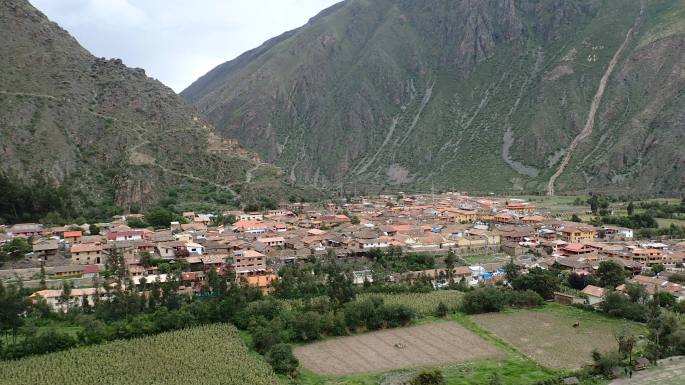
What must it be like to live in a small village already at way over 3,000 metres, where sheer mountains rise up directly above for maybe up to 1,000 to 2,000 metres more like a giant fence of random but all encompassing rock.
We have been in this environment for a few days now. I try to take some comfort from the fact that the mountains appear to be solid rock in light of the huge amounts of seismic activity in Peru. The train from Ollantaytambo to Aguas Calientes follows the river along a very narrow passage through the mountains. Sometimes it is too narrow and we pass through a tunnel. The peaks rise up above us like giants looking down benignly with the highest reaching a snow capped 5,700 metres. A number of snow caps are more easily seen on the return journey.
Meanwhile the river is like none I’ve ever seen before. Full of absolutely massive rocks, the water tumbles through at phenomenal speed in an absolutely lethal spectacle. It is awesomely mesmerising.
Maybe halfway into our 90 minute journey the vegetation changes from being quite sparse with cacti and bromeliads to a more sub tropical feel. Warmer temperatures and more rain allow high altitude palms and orchids to flourish.
We kept our eyes peeled for the Spectacle Bear and the National bird Cock of the Rock along the way but no luck there.
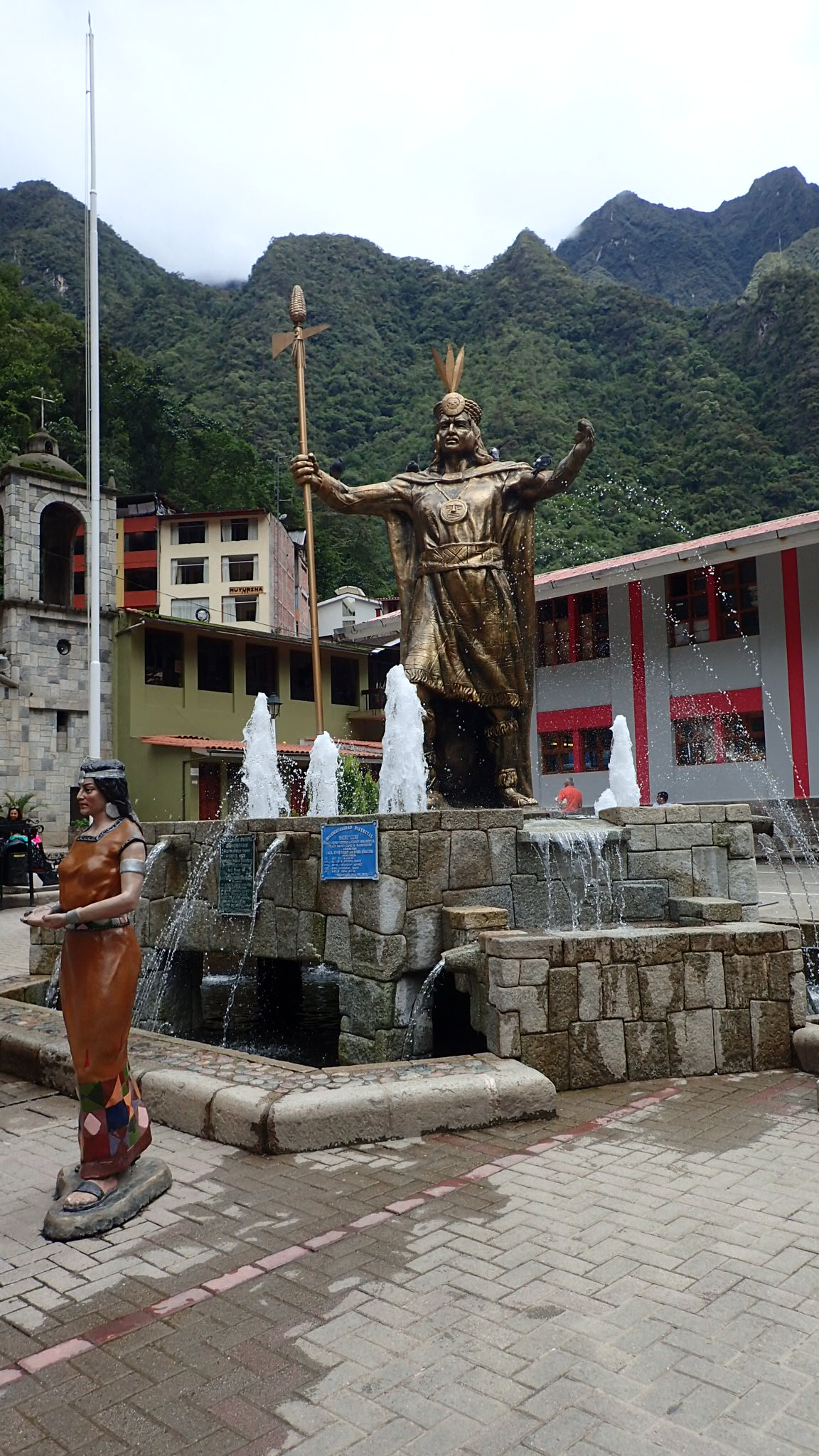
Aguas Calientes
Aguas Calientes is an end of the line pit stop with a feel of the wild west. Wall to wall eateries compete for your custom. Luckily someone from our hostel met us at the train as I don’t think my mud map would have worked in the rabbit warren. Looking over the rooftops reveals what looks like a shack shanty town on top of the touristy outlets at ground level.
Just up the steps is The Tree House restaurant. Obviously a foodie spot that we managed to luck into.
We meet people who like us have trained in to do Machu Picchu the next day. I would love to know how it panned out for some. A young Paraguayan woman who didn’t like heights and wasn’t sure she’d even go. An American woman just puffed out from walking up to the restaurant had a ticket to climb the mountain behind Machu Picchu which appears to be a vertical climb taking a couple of hours.
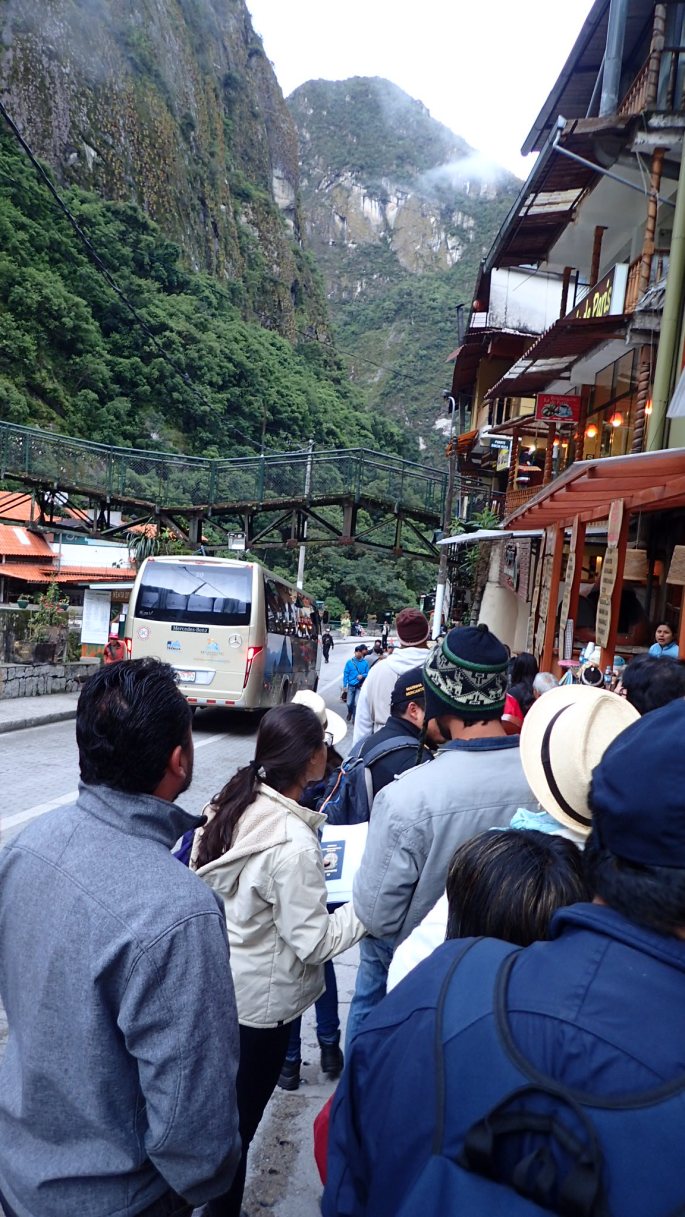
The bus queue in Aguas Calientes to get up to Machu Picchu already extended about 300 metres at 5.30am
We head out at 05.30 and the queue for the bus is good 300 metres long – and it’s uphill to get to the end of the queue. People would have been there at 03.30 to get the first bus. It’s pretty efficient though and we are on a bus in 40 minutes with a 20 minute ride up the mountain.
A number of fit young things are walking up from the base. Extremely hard work
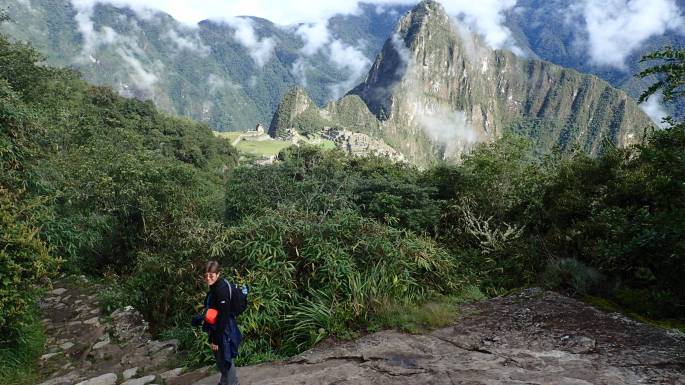
The clouds start to lift as we walk up to the Sun Gate
There is still cloud cover but we hopefully head up to the Sun Gate. Lots of early arrivers are heading down not having seen the sun. We pike at a great spot after 20 minutes and are rewarded with the sun breaking through the clouds wafting over the main site.
Fascinating with cloud cover, it is stunning in full sun light. We head down to join the masses. This is low season yet there are hundreds of people still and more continue to arrive.
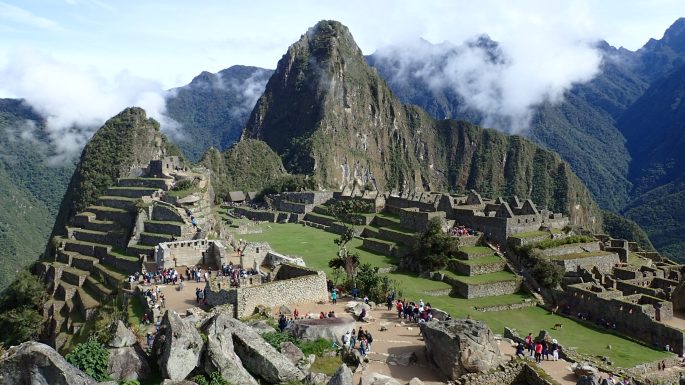
Looking awesome on a beautiful January day
My big mission is to find the location of my 1974 photo and recreate the event. I was already sure this would not be possible having seen many lovely places roped off.
We show the photo to one of the attendants. He smiled “Yes it is 3 Windows, but no puede”. OK, I can’t, so I find something a bit similar and Kerri snaps away until another attendant tells me I can’t have my leg hanging down.
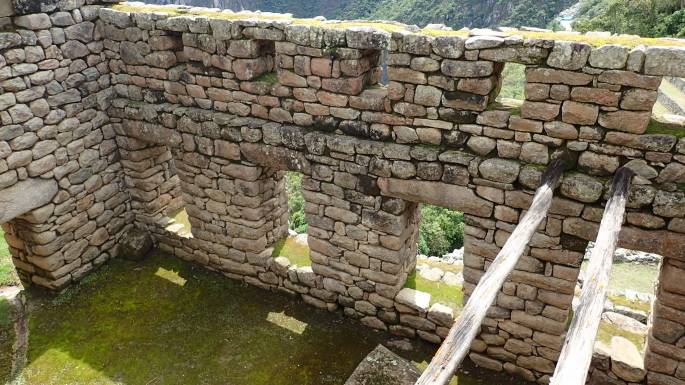
It has been a full on few days and we leave Machu Picchu satisfied but exhausted. We jagged the timing for the day. Around lunch time it started to pour rain – those who got a later start would not have had such a pleasant experience.
There are 2 seasons here, wet and dry. So, for visitors in the rainy season, an overnight in Aguas Calientes with a very early morning start to get up the mountain would be my top tips to give yourself the best chance of a great experience of this magical place. We haven’t been here that long but it seems to rain later in the day and overnight.
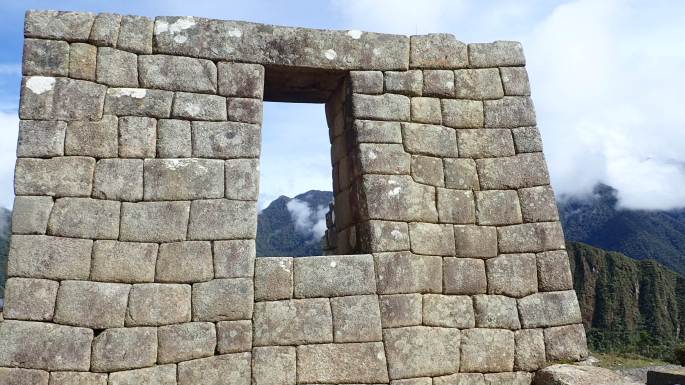
I am glad I first visited in an easier and less well touristed time when you could clamber wherever you liked, but it’s pretty special to return nearly 43 years later and fulfil that long held promise to myself. So here’s the homage to my youthful adventurous self albeit not quite as I planned. 1974 – 2017.
Finally we are heading for the Sacred Valley and will use Ollantaytambo as an entry and exit point. The collectivo drops us of in yet another charming village Plaza and we make our way to Intitambo, our resting spot for two nights.
What a warm and welcoming hostel. None of these mountain hostels have heating but seem to be very well designed and constructed with extremely cosy beds.
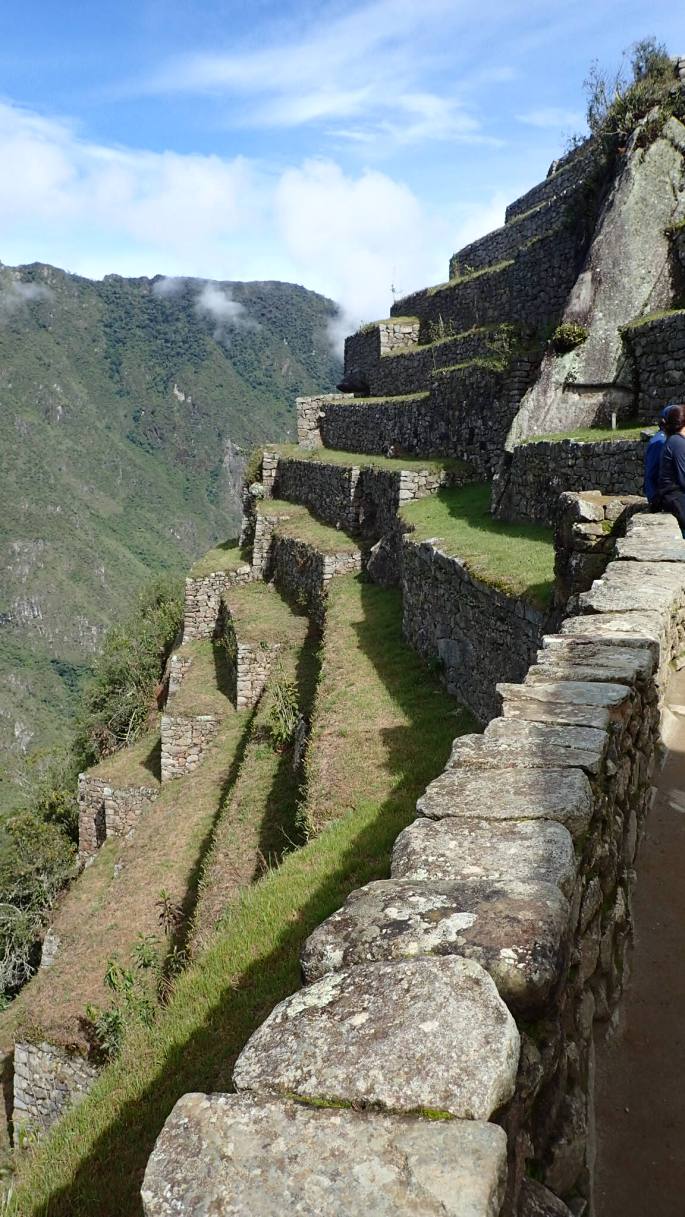
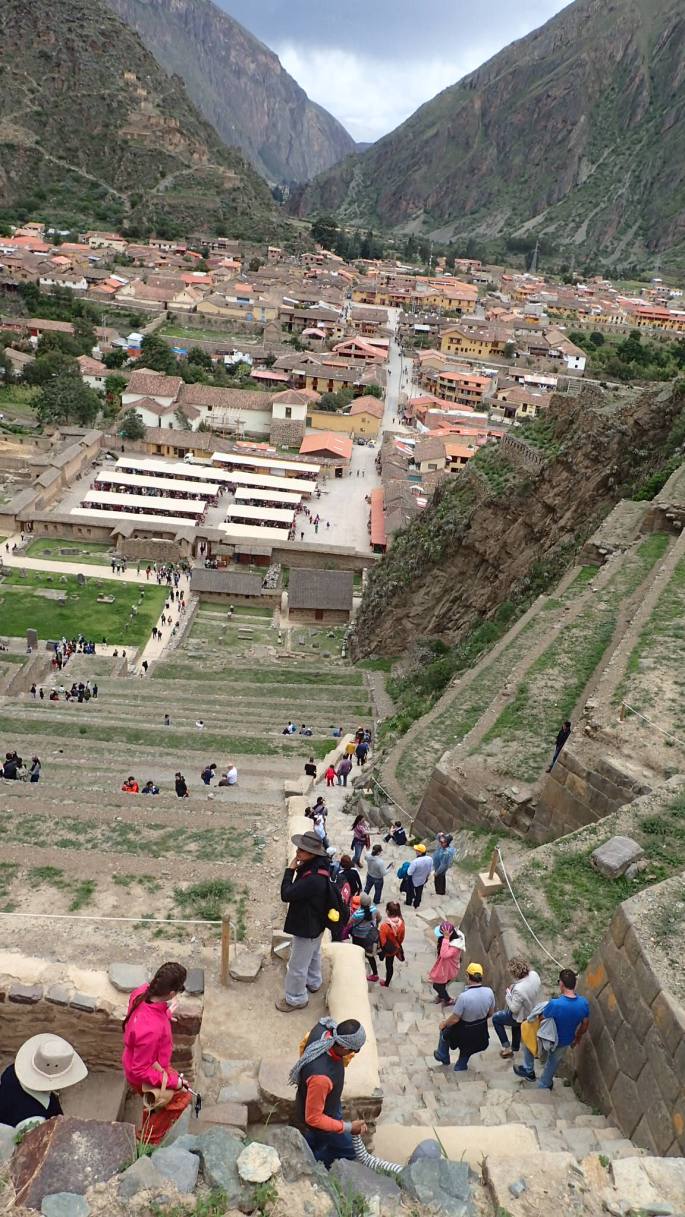
The terrace looks straight out onto the ruins and always up, up to the peaks of the surrounding mountains.
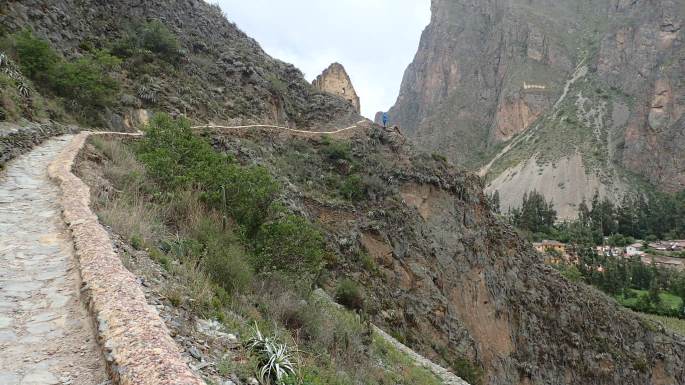
Looking back to Ollantaytambo. As always, a very steep climb.
The track is precarious when you get round to that structure in the distance.
Climbing any of the ruins in the Sacred Valley has an element of risk. We hear that the Pisac ruins are closed due to someone falling. Another person has died while doing a star jump for a photo and falling off a cliff – that is according to some reports. We see people doing exactly that so could be correct (star jumps that is, not falling).
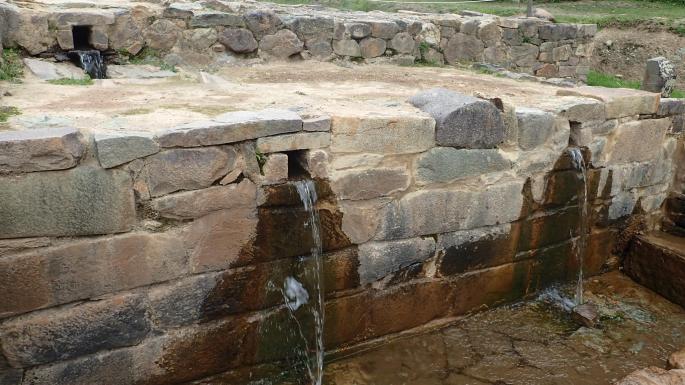
The Ollantaytambo ruins extend up the mountain with various temples and the ever present water features at the base. In the wet season, mornings seem to be the optimal time to set out. The tracks may be a little precarious in the rain, though the yellow ponchos high up tell the story that people do undertake it in the rain.
Time is obviously a factor for a lot of people heading to Machu Picchu, so many seem to head straight back to Cuzco. Exhaustion plus in my book after a big day at MP. But if time is not an issue, Ollantaytambo is a perfect spot with nice accommodation, food and coffee. What more could you need?
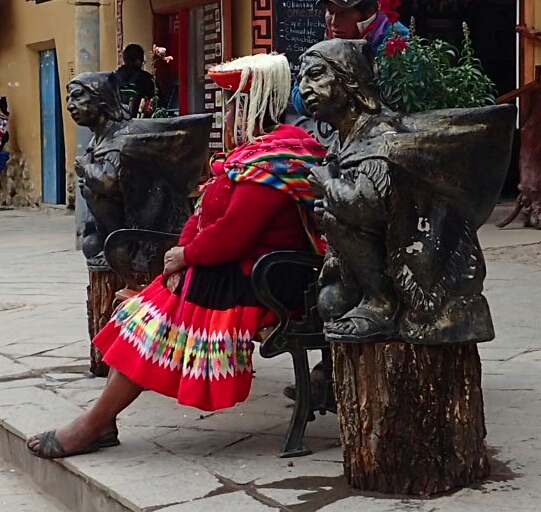
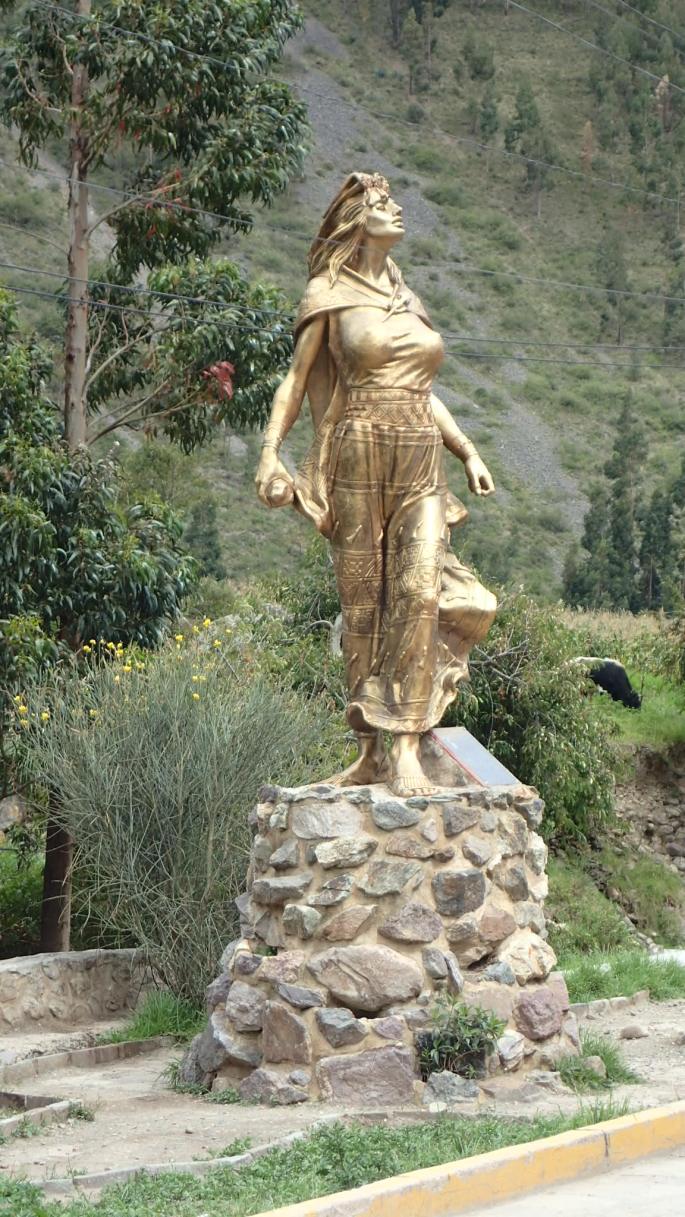
Kura Oqllo wife of an Inca king murdered by the Spanish, according to the sign. She is supremely impressive in spite of the statue being mounted with her head in the electrical wires.
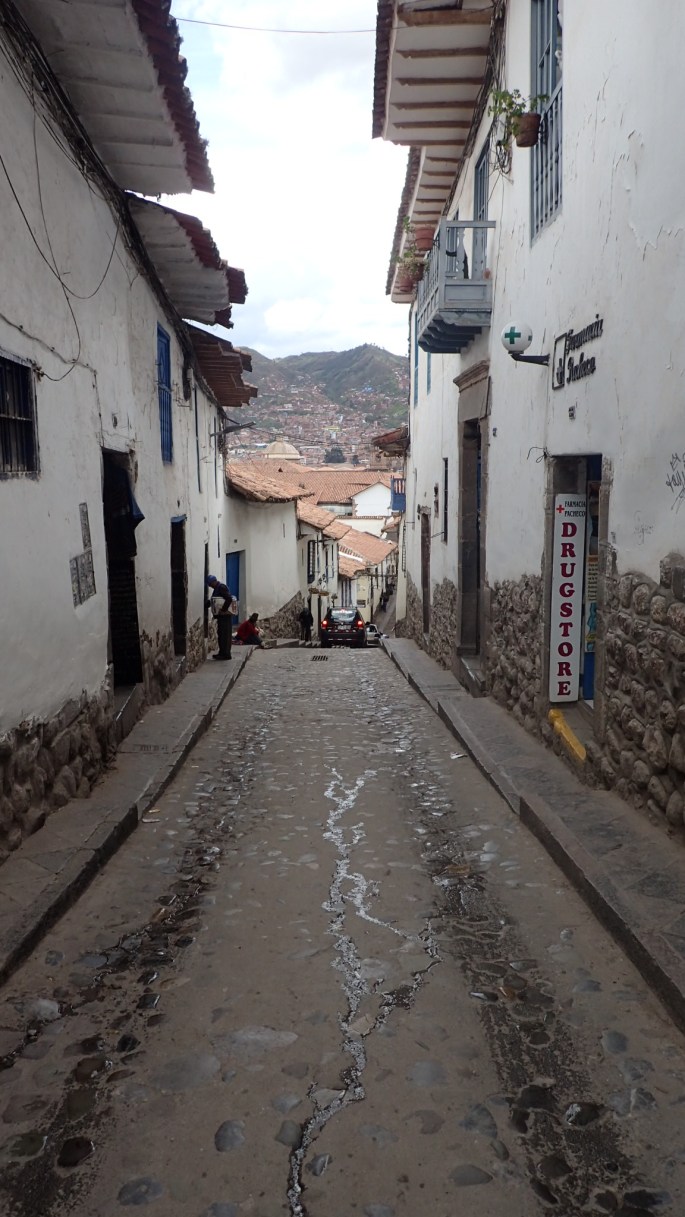
Cuzco is a gem in the Peruvian Andes. Hippie heaven in another time, now a flashpacker paradise. This time I fly in rather than take an arduous bus ride from Lima. The taxi winds its way in El Centro through streets absolutely never designed for vehicular traffic.
We rattle over cobble stones and take our chances with the oncoming vehicles. Backing up is the only option, in the narrow streets that are reminiscent of Sevilla in terms of the dimensions.
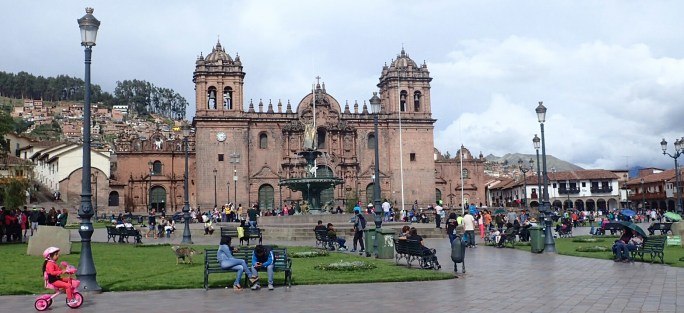
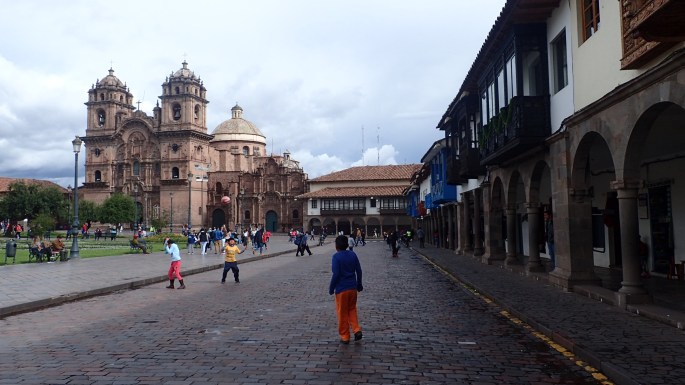
At our highest elevation so far, there is no time to worry about altitude sickness, important business to attend to. First stop Plaza Mayor for Peru rail, but we just have to stop and take it in, the Plaza is splendidly beautiful and grand.
Train tickets to Aguas Calientes in hand and at phenomenal expense for a 90 minute journey, next stop the government department that sells entry tickets to Machu Picchu. A bit of a queue here and luckily we have plenty of soles because US$ are not accepted. Passports are required for both the train and MP tickets.
So over $300 each all up just to get the return train from Ollantaytambo to Aguas Calientes and to get into MP. Will be another US$50 for the return bus from AC to MP and return. Luckily it is only about $4 to get to Ollantaytambo from Cusco!
Priorities complete, we can now eat lunch, it’s nearly 4pm.
One of the things I love about South America and Cuba as well, is that there is never a wrong time to eat. If you want a 3 course meal at 4pm, no problem. If it’s only a small snack at 8pm also no problem.
Back to our lovely hostel, so convenient apart from the fact it’s uphill with just 67 or so steps at the end of the climb – that’s Cuzco. After 3 weeks of internet deprivation in Cuba, there is a lot of catch up and research waiting to be done.
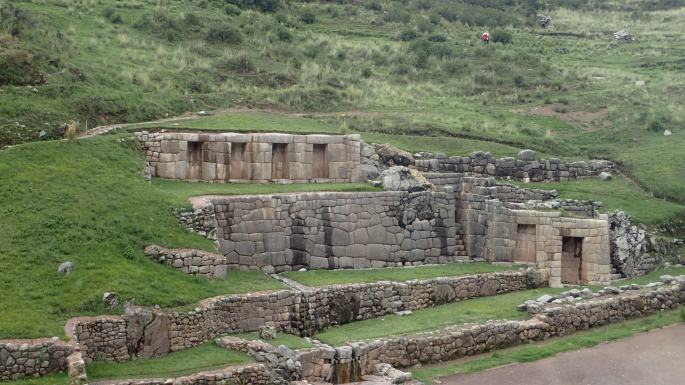
Day 2 in Cuzco and instead of searching for the local bus, we take the expensive option and get a taxi to Tambomachay. It’s only about 8kms up the road, and the key word is UP. We go to about 3,700 metres and the plan is to walk back to Cuzco taking in the Inca ruins on the way.
There is quite a long walk in to the Tambomachay ruins and we are puffing a bit even on the flat to start with. We purchase the tourist ticket that covers 16 different sites through the Sacred Valley and will cover us for 10 days.
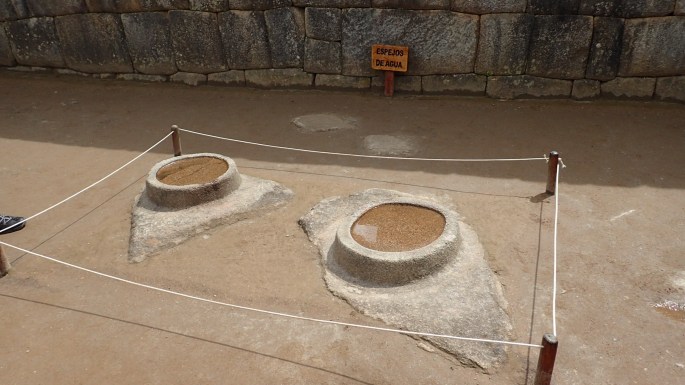
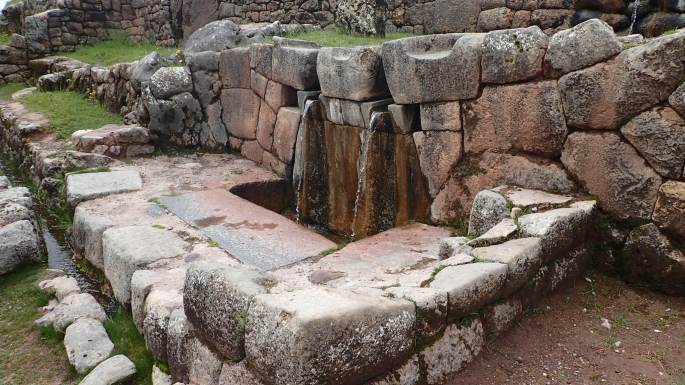
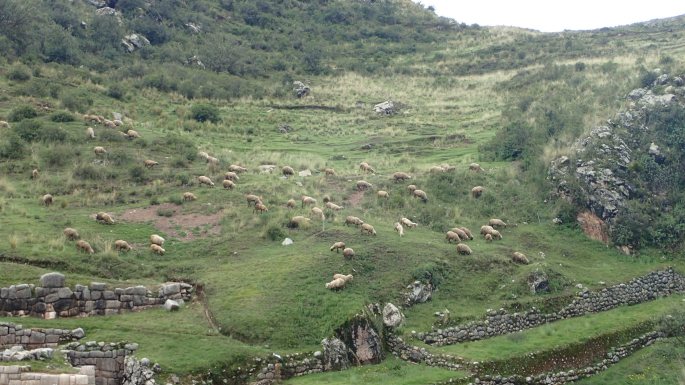
Such a beautiful location with the inevitable fast flowing water that seems to be present in every Andean location in this part of Peru. A herd of sheep flash down the adjacent hillside adding a touch of life to the ancient beauty we are exploring.
Just across the road is Pura Pucara, stop two in the ruins exploration for the day.
From here, we decide to take unmarked trails cross country to get to the next site. I have written some directional notes so we set off confidently past a huge stand of very tall eucalypts.
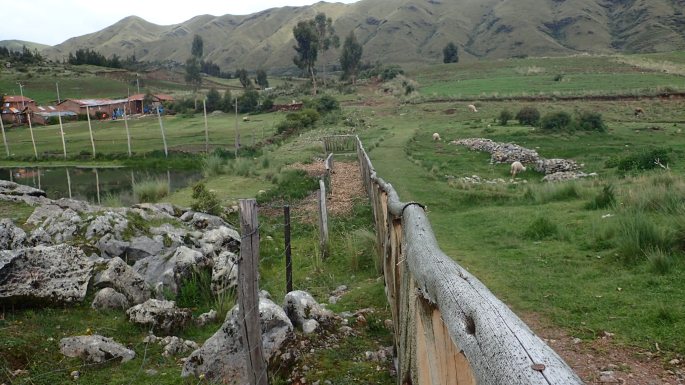
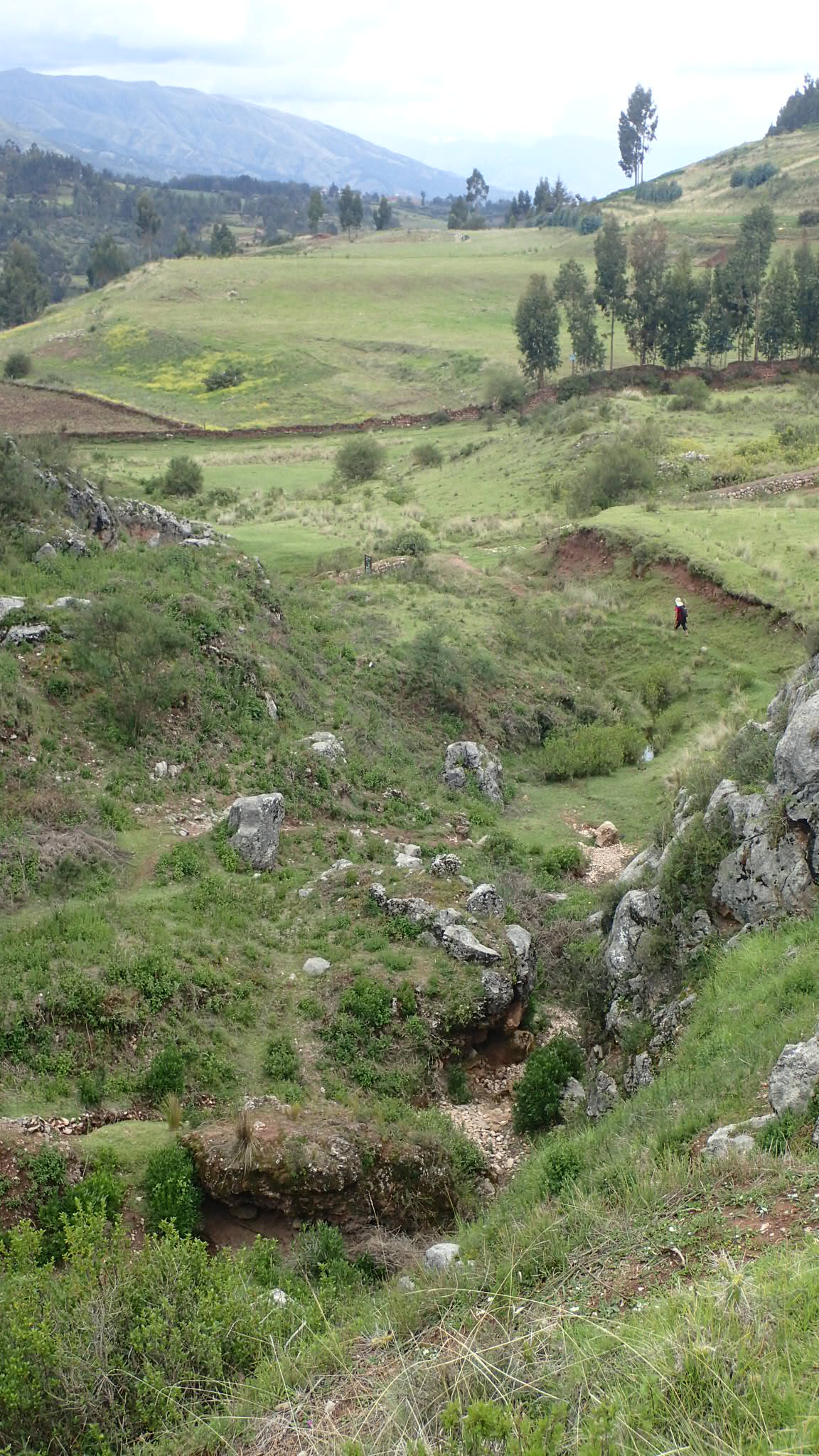
Immediately we know this was a great decision. It is so green, lots of rain here, and the countryside is stunning. We pass crops, stock and farms.
After about half an hour or so, my notes seem to taper and we are on the verge of heading back toward the road. Suddenly, from behind, we are hailed. “Going to the Temple of the Moon? I am going, come with me.”
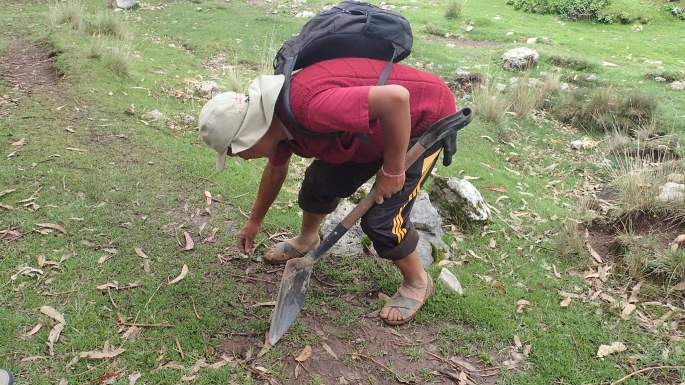
Our impromptu guide sets a cracking pace
Carrying an enormous shovel, the local man is clearly on his way to work somewhere. Seems like a great option so we take up the offer. He speaks no English but endeavours to educate us on the way, drawing a mud map of the extent of the Inca empire.
He points out the potatoes, an amazing range available in Peru, and plucks two different sorts of wild mint. The aroma of the first is so strong and aromatic, unlike any mint I have smelt before.
In spite of these interludes, he is clearly in a hurry. “Walk faster”.
We walk at an absolutely cracking pace, luckily mostly downhill. I am mesmerised by his feet and legs and keep a close eye on where he is stepping as we proceed along the rough and sometimes wet track.
His lower legs and feet look as if they have been beautifully crafted from clay, they are so sturdy, brown, strong and slightly muddy in the simple sandals.
Muy tranquilo he says waving at the spectacular landscape we are walking through. Absolutely, there is no better description to describe where we are. Just a wonderful 20 minutes or so sharing a small journey with this lovely man.
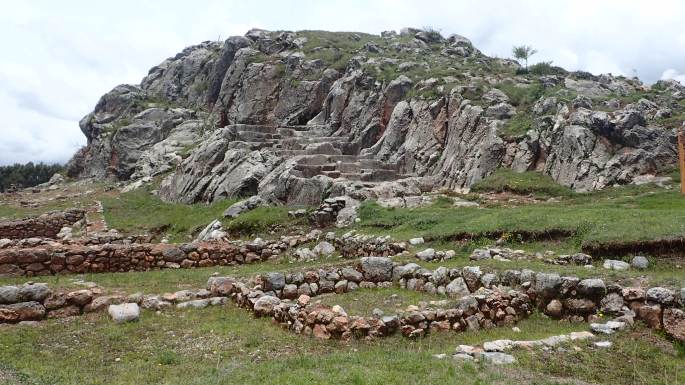
The Temple of the Moon is a good resting spot after our exertions in getting there. Having seen no one for an hour or more, it suddenly becomes comparatively busy. Locals are enjoying a Sunday picnic and tourists are coming in on horses from the lower ruins. Feels pretty special to have had that interlude on our own.
Next stop Q’enqa followed by the big one Saqsahuaman.
Coming from this direction and after such a huge effort already, it seems like a very long walk in to Saqsa. Beats coming the other way though which is as uphill as you can get from Cuzco.
Have to say I am a bit excited as this is one place I visited in 1974 and here it is. Wonderful to see again.
In spite of weary bodies, we have to do the main section, then it is downhill, sometimes just as difficult as uphill, back to Cuzco.
Plans for further activities are abandoned as we are stuffed to use the vernacular, so have a late lunch again, a coffee at our favourite spot and retire for the day with a cup of coca leaf tea.
The bed is super cosy with blankets and doona, no heating needed though I sneeze if I venture to the bathroom in bare feet. Quite cold at night. In spite of walking maybe 20kms at altitude over about 5 or 6 hours I don’t sleep as well as I thought I would. Maybe the body is overtired or maybe a couple of late coca leaf teas was not a good idea.
Real yoghurt, white and creamy is a treat for breakfast. I have to say that because to date Peruvian yoghurt has been bright pink and fairly liquid. Cuzco offers plenty of culinary treats. Kerri tries alpaca steak which she enjoys.
What I enjoy is a menu that has GF written after many meal options. That’s a first for me in South America even though I have no problem finding gluten free food. It’s a little more expensive not being able to eat a sandwich or pizza which seem to be available everywhere.
You’ve not heard anything until you hear prolonged, enormously loud claps of thunder bounce around the surrounding Andes mountains. Stupendously awesome. Even our favourite coffee barista was moved to call on her God at the noise level.
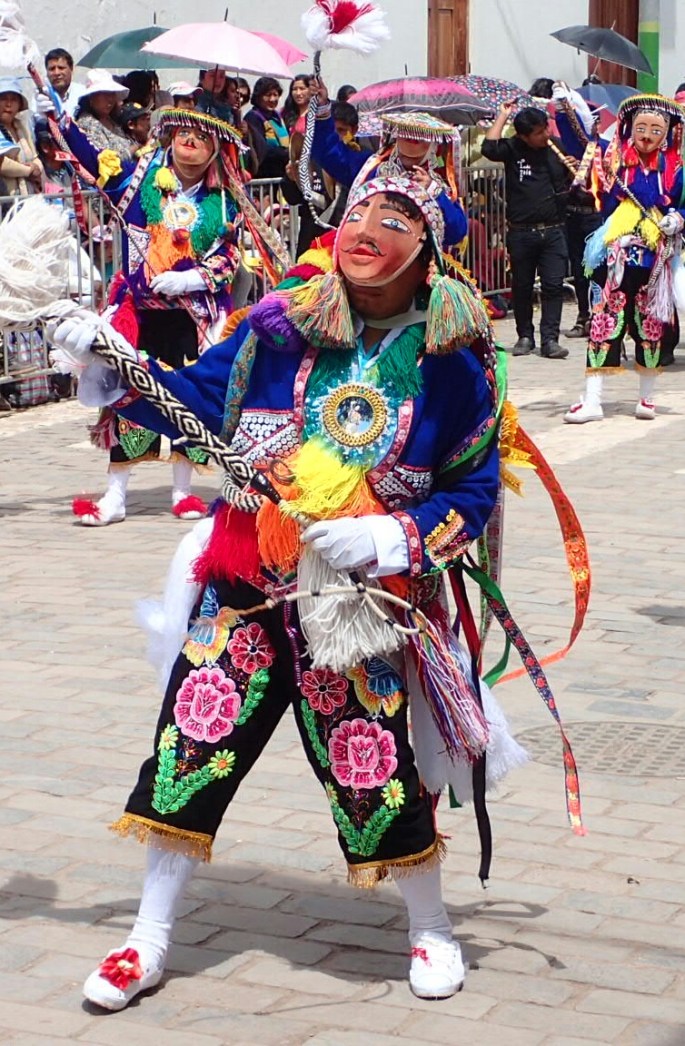
She recovers enough to tell us in such careful Spanish that I am able to get most of it, about the Fiestas that are currently happening in Cuzco. Every day different areas or suburbs are celebrating their saints. With a warning to be very careful of our belongings in the crowds, she encourages us to go to one. Sounds too good to miss.
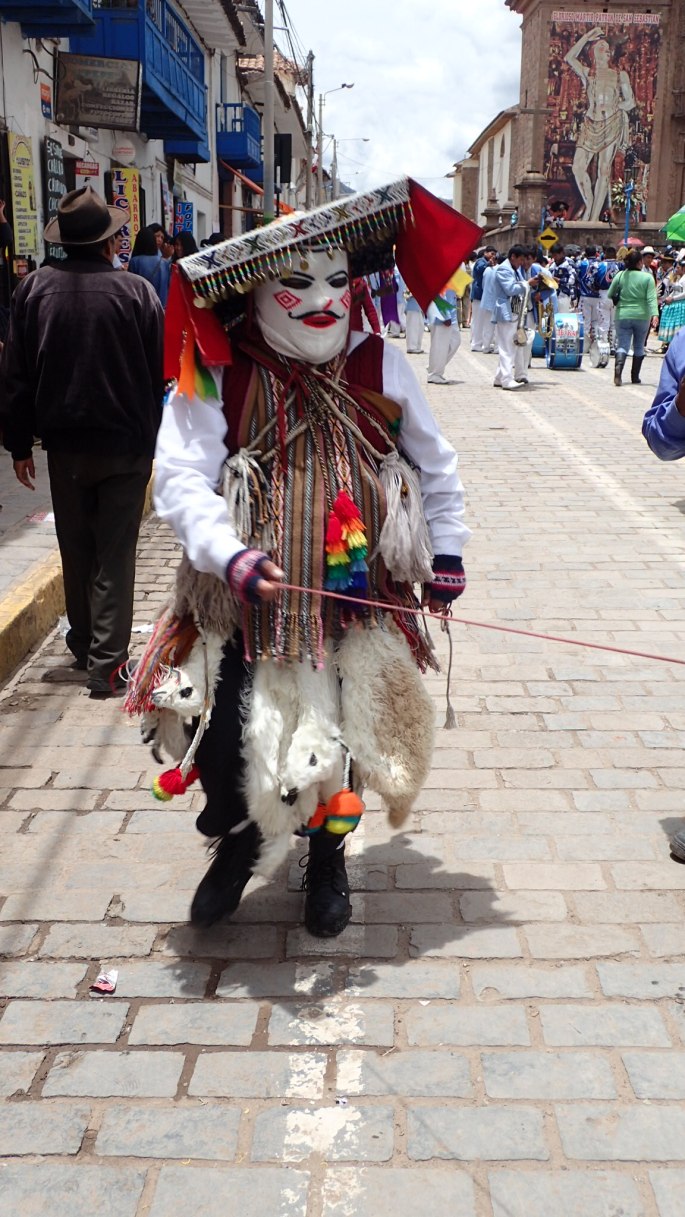
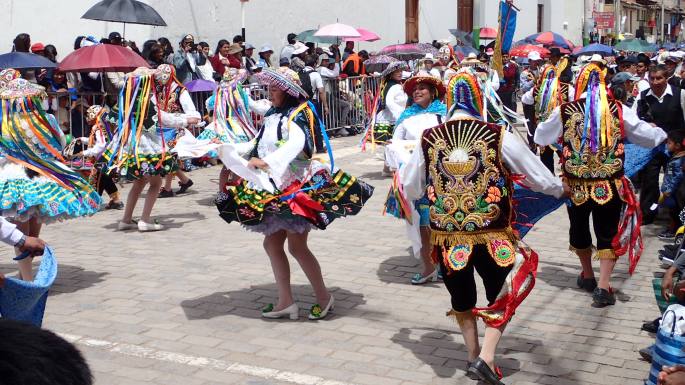
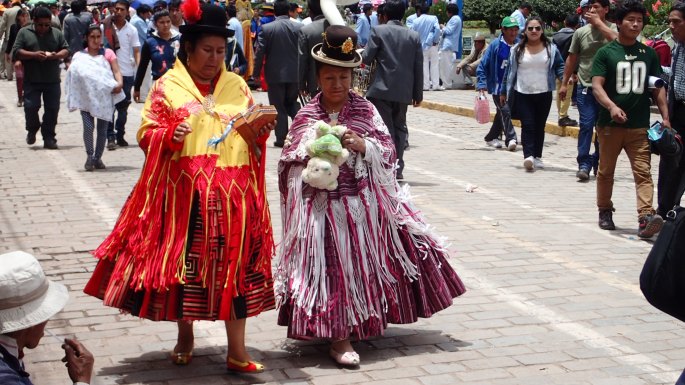
San Sebastian Plaza is a riot of colour and noise. Participants are dressed in so many varieties of elaborate costumes. Masses of bands are playing so loudly the noise seems to vibrate right through me. As they finally start to march off, various band members gradually straggle out from a nearby drinking establishment. The crowds wait patiently but surge and relocate as the procession moves on. The dancers and musicians must be exhausted by the end. The day is very hot and most of the costumes are all encompassing often including full face masks.
Guinea pig is popular
Tomorrow we head off for three days to Ollantaytambo and Aguas Calientes for the Machu Picchu adventure.
Lima has been our most visited transit stop along with Guayaquil but this is the final visit for this trip.
After three weeks in Cuba, the shopping opportunities appear so vast in Lima. There is such limited consumer availability visible to a visitor to Cuba and it is hard to find a shop as we know it selling anything. They obviously exist somewhere as our Casa owner was very proud of her new chairs.
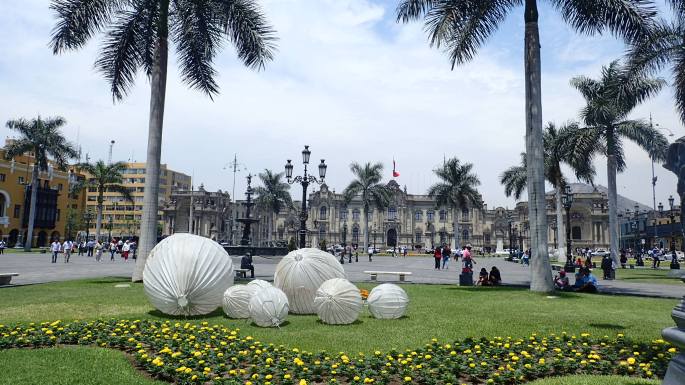
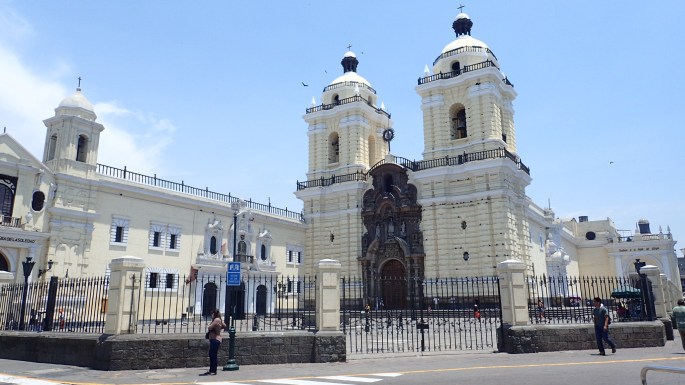
Plaza Mayor in the Historical Centre of Lima is magnificent. The police presence on the corners is a little surprising but they looked fairly relaxed with their riot shelds propped up in front of them. The Governors palace taking up one whole side may be the reason for the security presence.
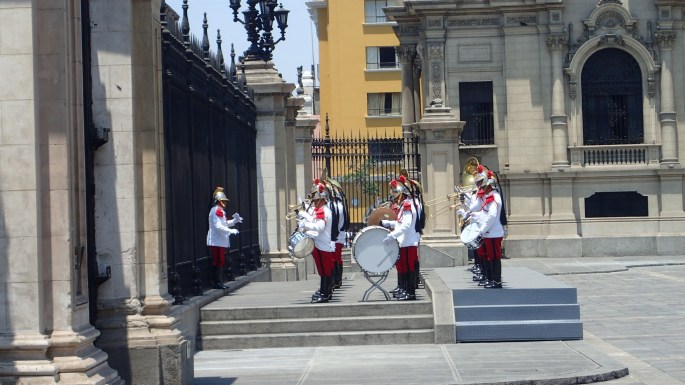
A brass band playing in the courtyard attracts plenty of cameras but the guards keep everyone well back from the wall. If you want a photo of the well fitted out band, it will be framed with the slats of the metal wall.
Our attention is drawn to the buildings on the other side which look strikingly magnificent. For around $10 we get a ticket that provides entry to the the cathedral and the adjacent Archbishops residence, now a museum.
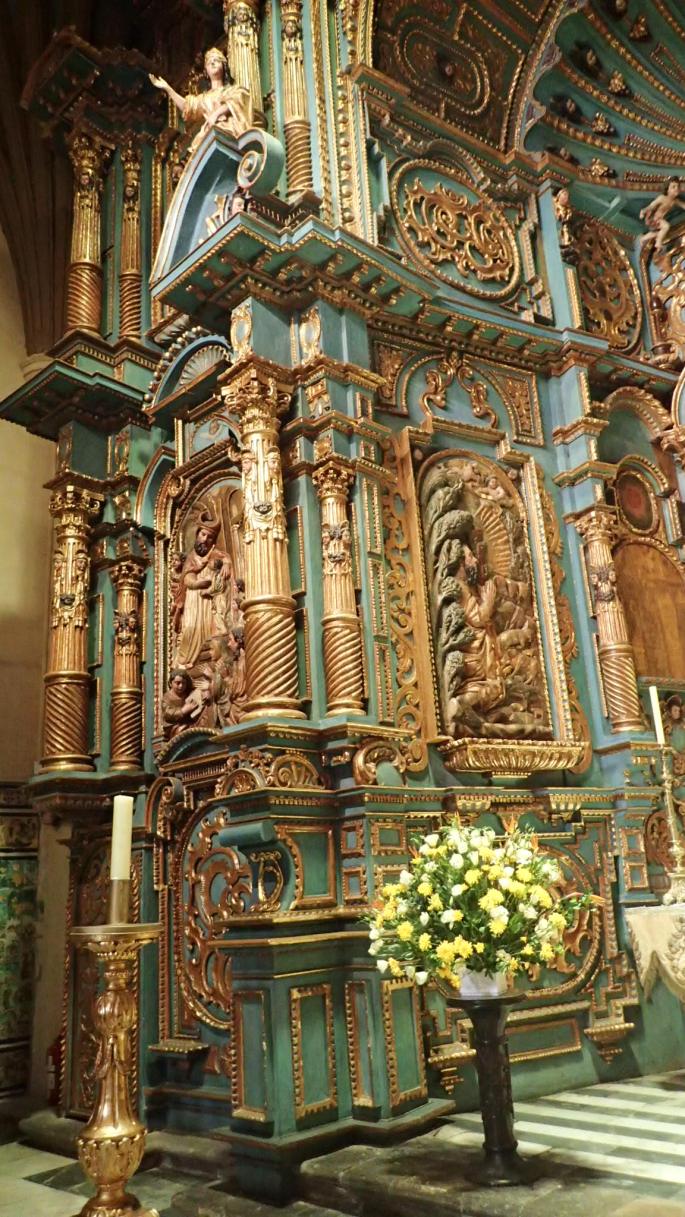
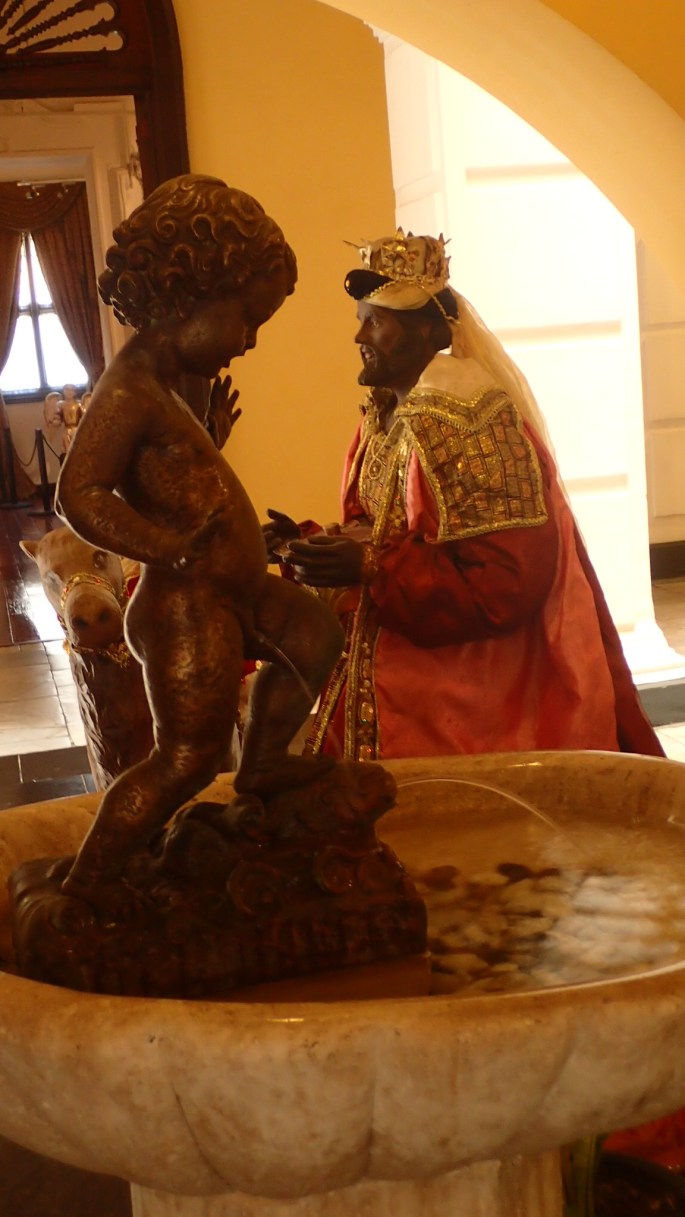
Full of religious art in every medium from wooden life size statues, 3D tableaux, paintings and objects, we tour the opulent rooms of the museum which still house all the furnishings that were presumably in use when last occupied. Bizarrely, a very large nativity scene is in place right beside a Lima version of the Manneken Pis, the original being located in Brussels.
To say the Lima cathedral is awesome in size barely gives a true indication of the grandeur of the building. The mortal remains of Pisarro rest here in a prominent place, along with those of hundreds of lesser folk in the catacombs.
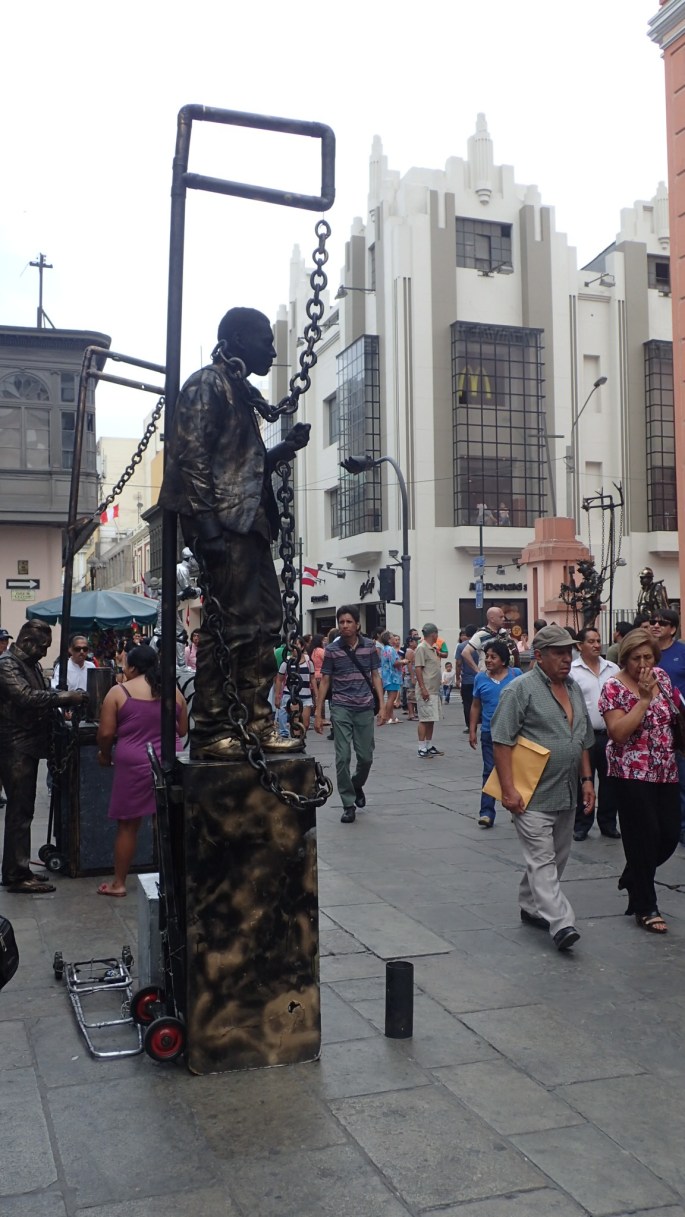
Live street art is popular along the main pedestrian boulevard down to the Plaza. Chains seemed to be a big thing with some of the “statues”.
At night Plaza San Martin and the surrounding area was very lively. Crowds gathered around people who seemed to have a political or religious opinion they needed to express. Lots of bars and eating places.
Just a short stay and such a different, richer experience to staying in the Miraflores area.
We were sad to leave our lovely Casa in Playa Larga but it is nice to be back in Havana after two weeks on the road. Maura greets us like long lost members of the family.
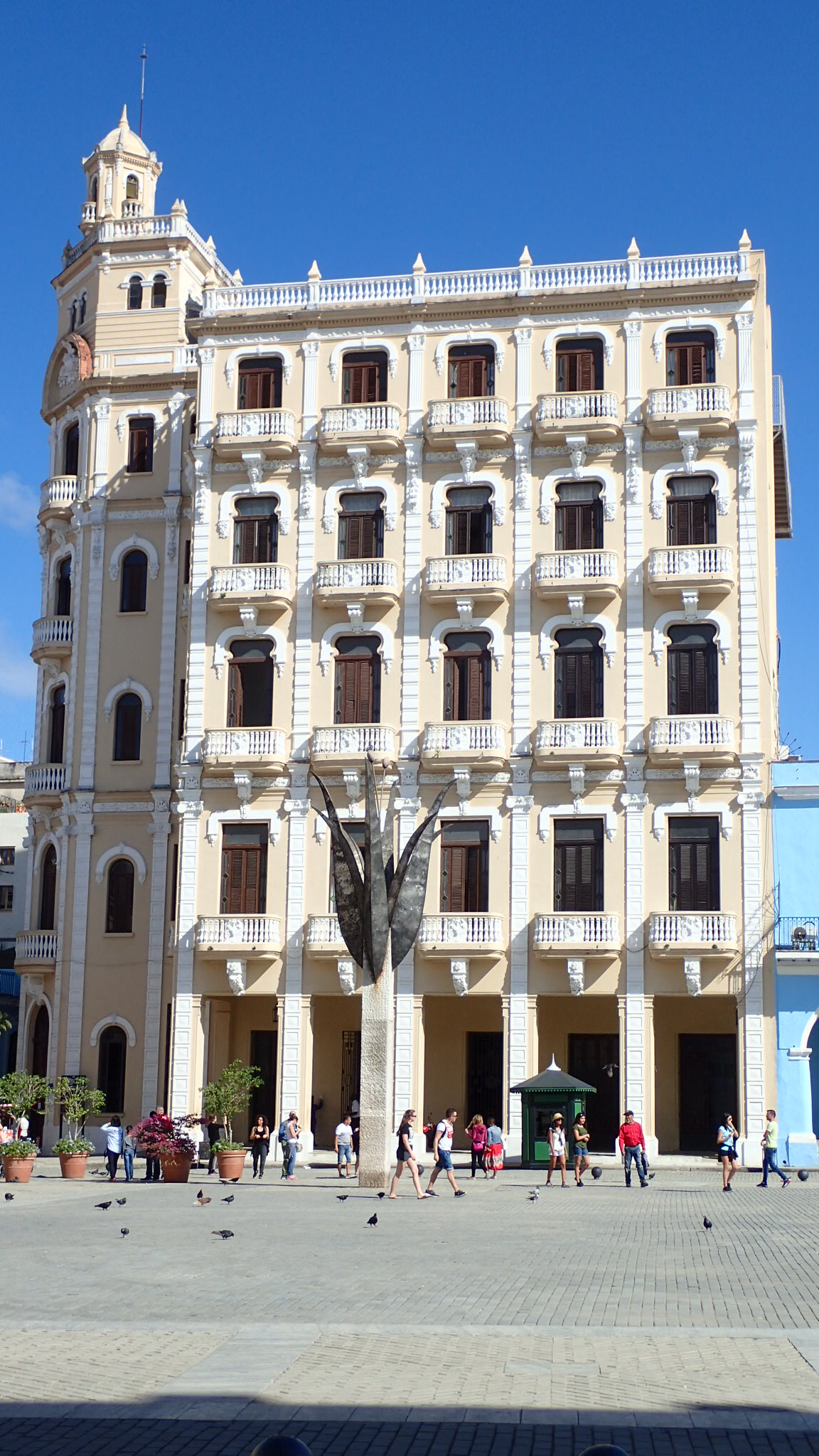
We head out on the now familiar streets where the vibrancy and energy, the smells and the sounds of the city tantalise our senses. People rattle small musical instruments to draw our attention to their tiny shop, otherwise missed in the mass of other sights crowding our vision.
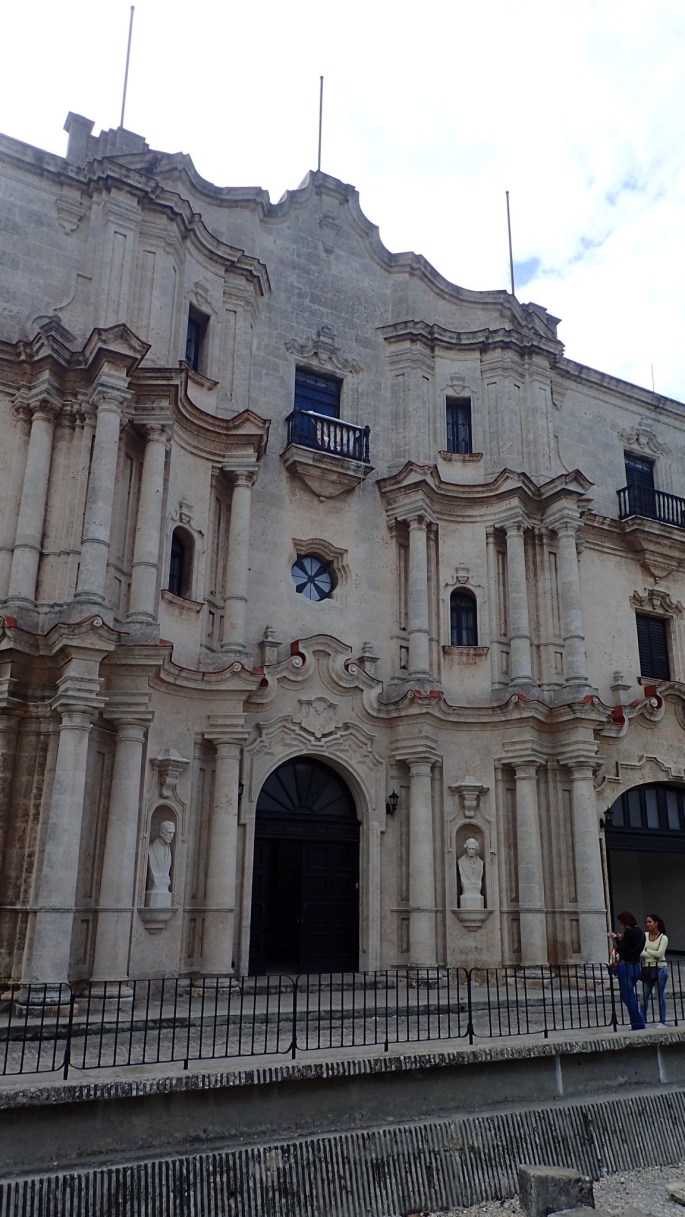
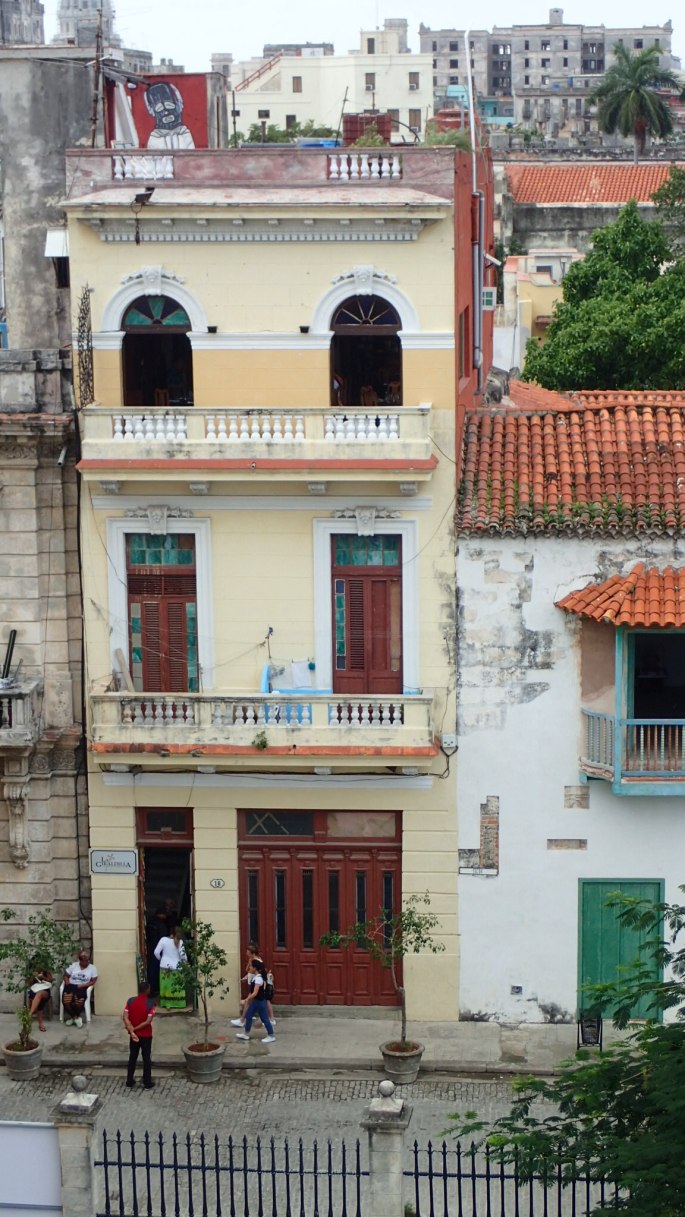
A beautiful old building housing a gallery is worth a look. Attendants wave us in but soon make a feeble attempt at guiding us round the art in hopes of a tip.
A young man claiming to be a Canadian Punjabi attempts to befriend us as we sip our generous limonade frappes. His English is perfect and his spiel is beguiling but I am sure it is a scam of some kind so we deter him from joining us. I had seen a man claiming to be a Mexican try the same thing with two other foreign women on our first stay in Havana.
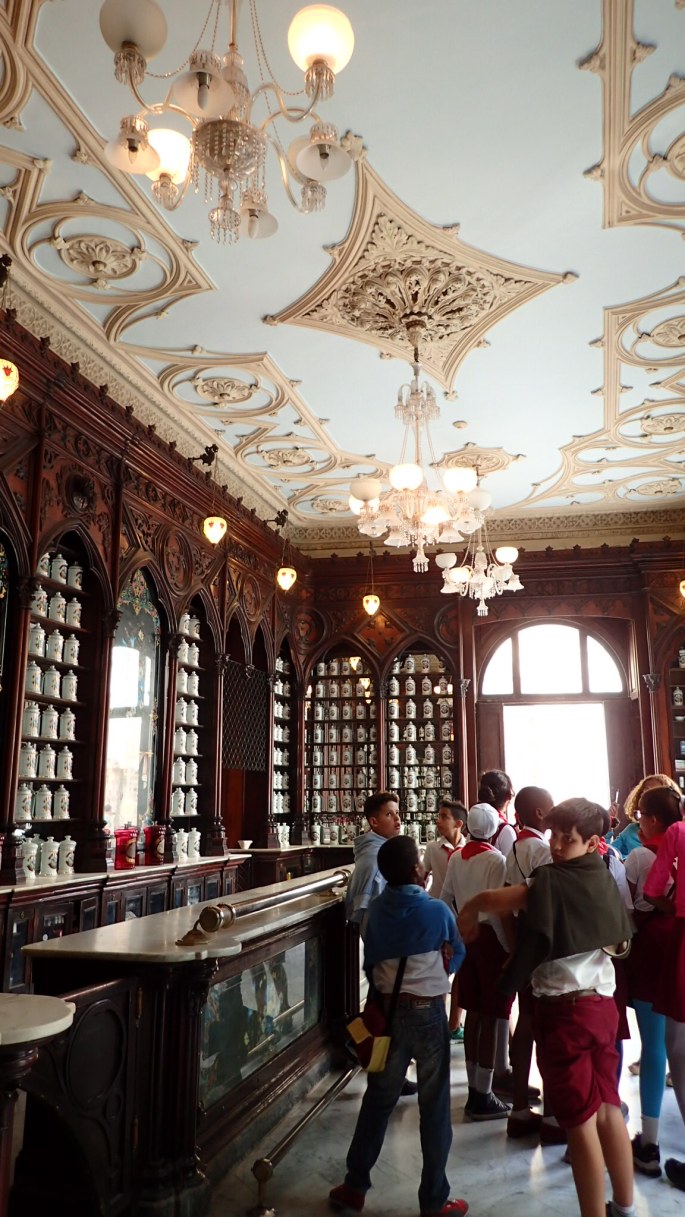
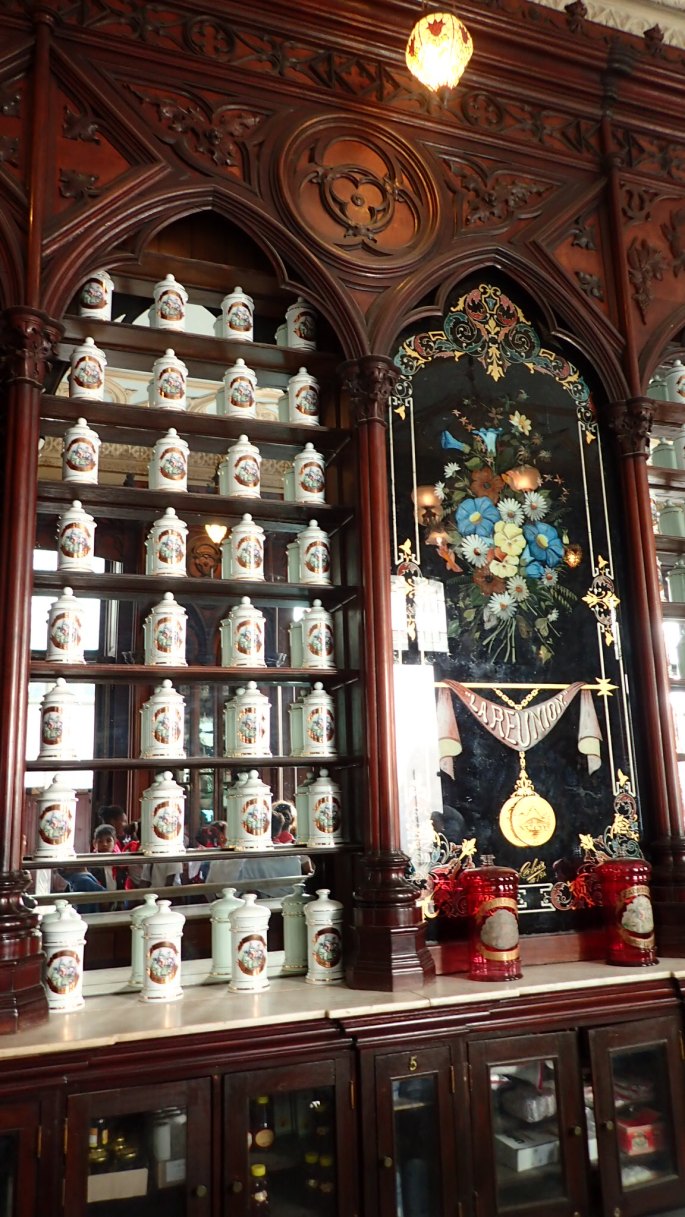
Beautiful old pharmacy, Havana
The local young men trying to befriend and help you are much easier to spot but it does require persistent head down walking on to deter them. Do not engage, is my catch phrase for these occasions.
We meet so many wonderful people though, generous, helpful, happy in themselves.
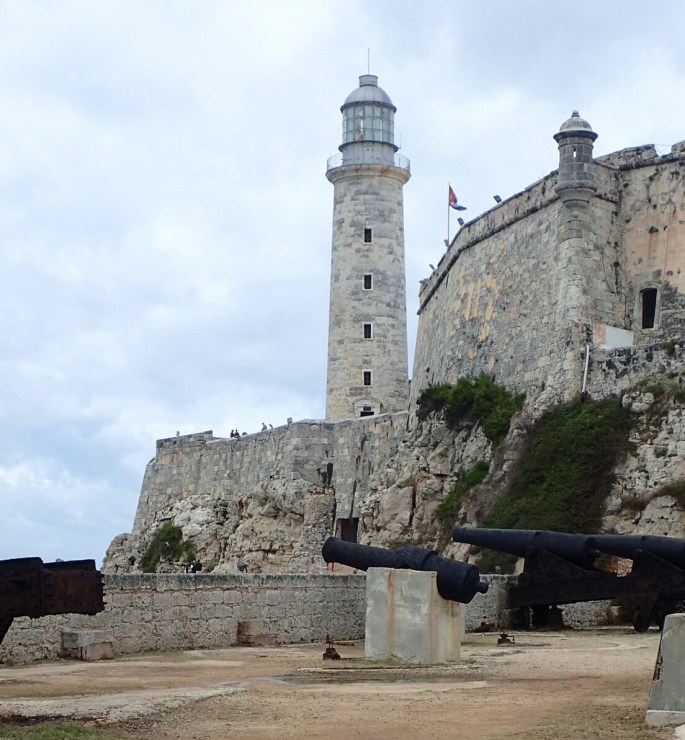
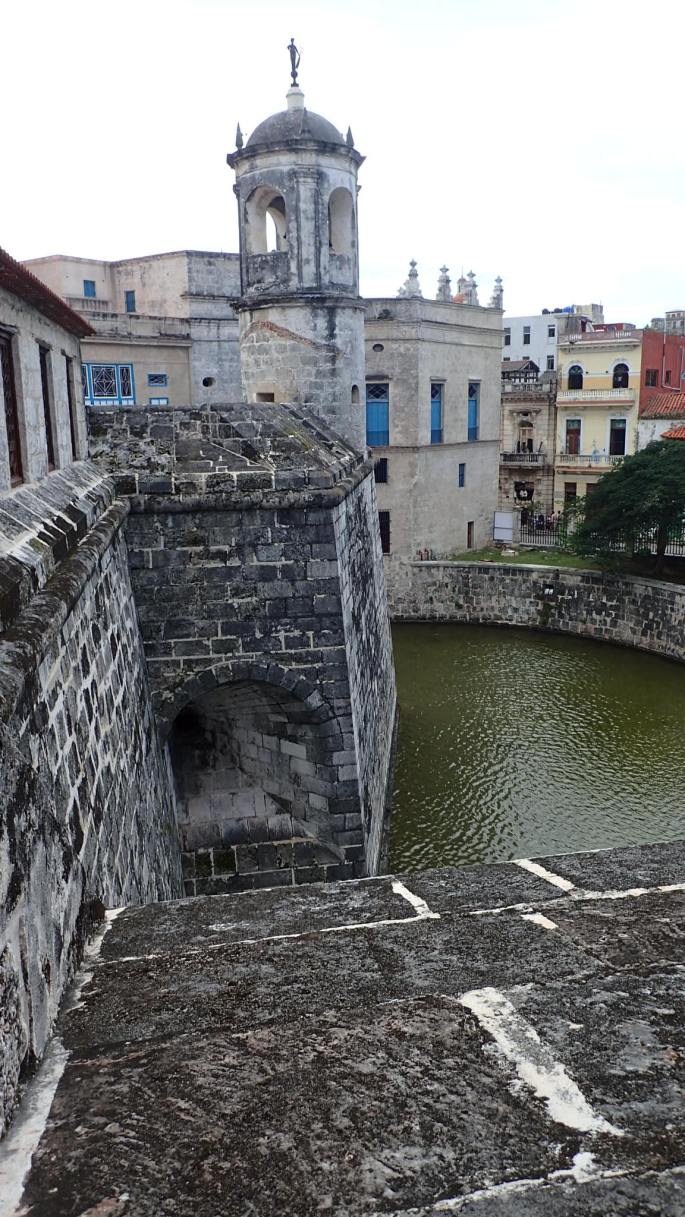
El Morro
Our last full day is finally the excursion to El Morro, the massive fort on the other side of the channel entrance to Havana Harbour. Built in the 16th century to try to protect Havana from pirates not to mention the French and the English invaders.
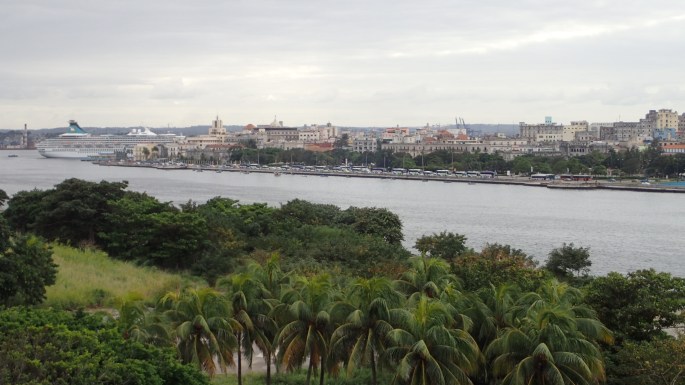
Havana skyline from El Morro
We walk in the footsteps of so many in this long history of Havana. Those who tried to protect the city and where fierce battles were engaged, but also where many more friendly visitors came to visit the massive fort and to admire the Havana skyline from the other side over the centuries.
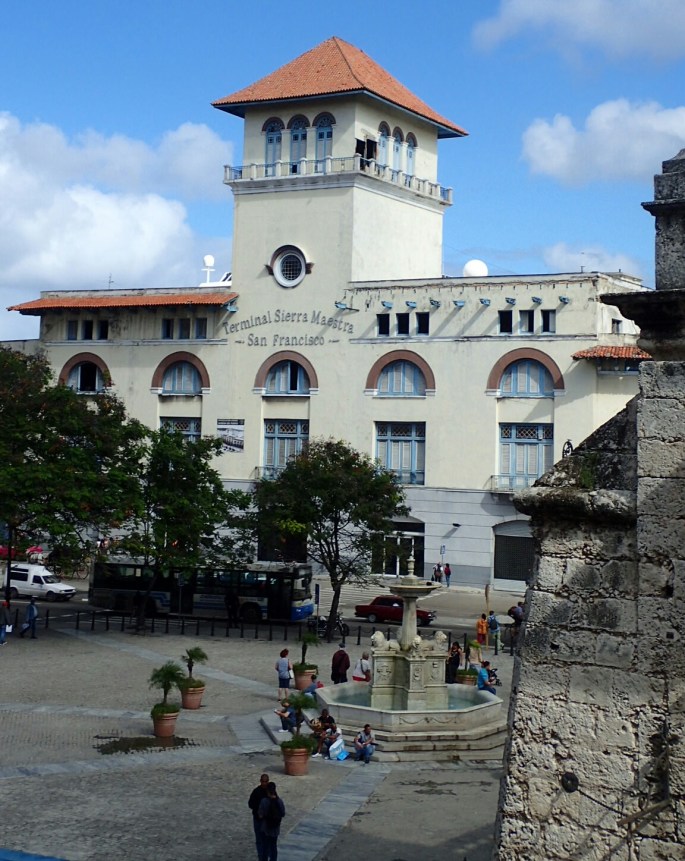
El Morro from Havana
In a bookshop in tiny Remedios, I found a book called Travelers’ Tales of Old Cuba. Fascinating letters and diary entries the first being from 1678. There are many descriptions from travelers in the 19th century most of whom include their visit to El Morro.
Cuba has a rich and often bloodthirsty history. The original trusting inhabitants were wiped out. It was the haunt of pirates and the location of a slave trade triggered mainly for the sugar plantations.
The English finally took El Morro from the land side in tne 18th century after failing to breach it from the sea. There is a very good history of that bloody battle located at El Morro itself.
There are so many memorable things about Havana and Cuba. At dawn, men call out in the street, sometimes with a whistle in the city to attract attention, selling fresh bread and other produce. The jolt to your senses as the cannon belts out its regular 9pm round, so loud from where we are staying in Havana Vieja.
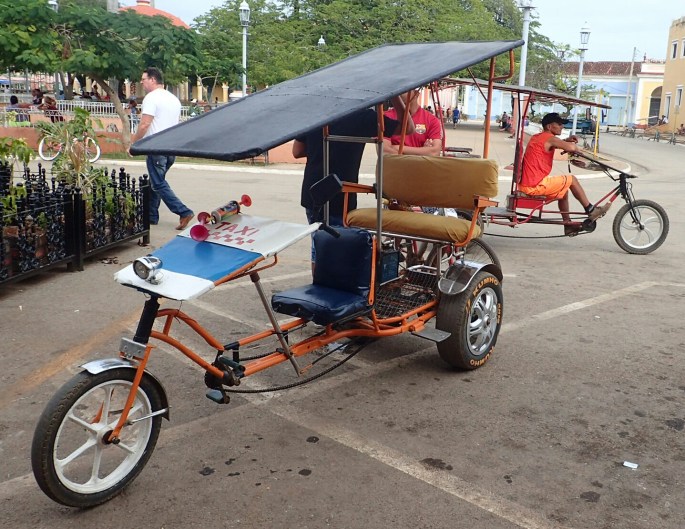
Patience is the word here for so many things. I love the road courtesy, seeing no evidence whatsoever of road rage. A horse and cart or a bicycle taxi blocking the way is no problem at all, no matter how long it takes to pass safely.
Life has freed up in the last 7 years or so and in general many people have a little more than they did. However it is expensive and still hard to get many things. Absolutely anything could be repaired on the street by someone in Havana is my memory from 10 years ago. Now it is rarer to see a repair man on a pavement stall.
Street repairs
We met Antonio working one of his three jobs as a carpark attendant who was struggling to make ends meet. Another lovely man, a Doctor, waiting to collect tourists with his beautiful 1951 classic car, shared a little about his life. No matter your occupation, everyone is paid the same, so any connection you can make with the tourist dollar will help to make life easier.
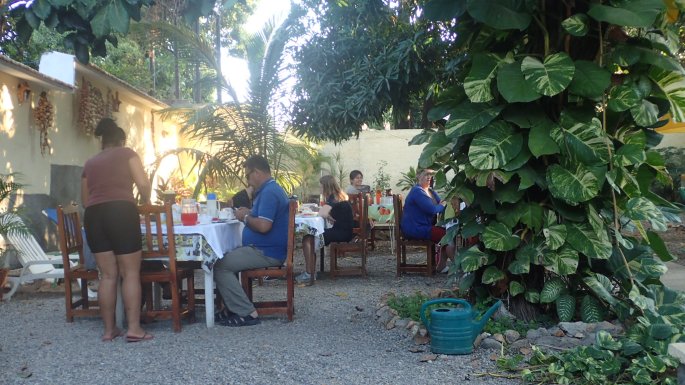
We hit the trifecta in our Trinidad Casa. Toilet works first time, every time, water pressure in the shower is excellent plus there is very hot water. Our hosts have a lovely large and cool home that opens onto a very big back garden where the breakfast tables are located under the trees.
Our taxi collectivo driver from Cienfuegos had backed up for another fare, driving to Remedios again to take us back down south to Trinidad. He gets a little more than his fare as sadly I leave my Guayaquil cap in the back. I was very fond of that cap.
This young driver has an eye for the ladies. Blatantly checks out any young females and picks up any cute ones who are waiting for a lift. So many people are waiting on the roads, must be a difficult life trying to get around.
Breakfast in the garden
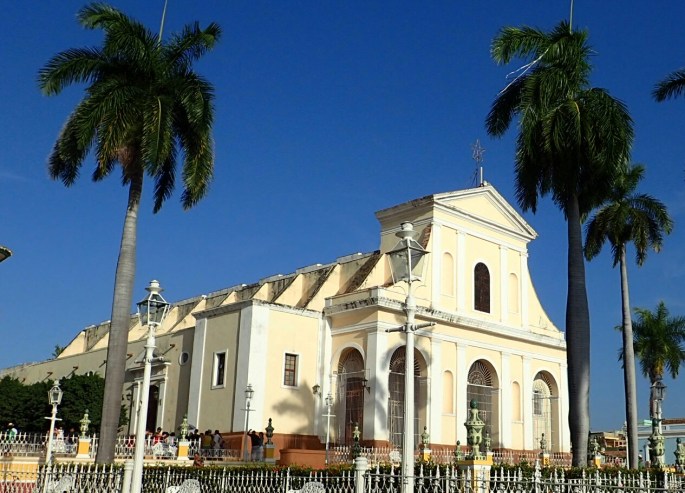
Trinidad is packed with tourists but not so bad once you get away from Plaza Mayor where the prices are high, the music tumbles out from every venue, and the cocktails flow. Cocktails are cheap and if you are just on vacation for a week or two….
Little bit of street repair.
The small cobble stones sit very unevenly and extremely randomly in all the central streets. Water bubbling up and running freely down the streets adds to the sometimes gymnastic requirements to get around. A brief shower of rain on our first night, dining on an open upstairs balcony restaurant, made for a cautious walk home. Wonder how many cocktail initiated ankle twistings there have been over the years?
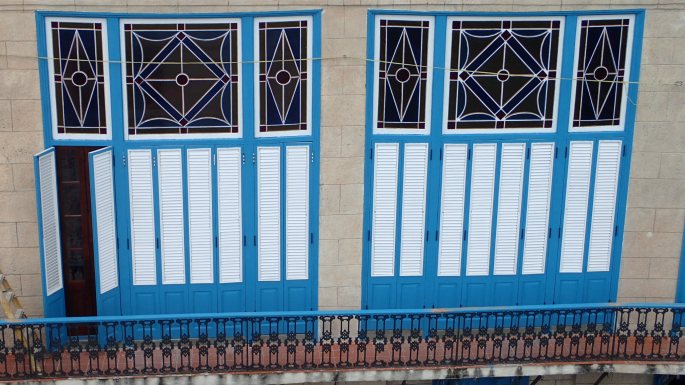
Doorways are a treat
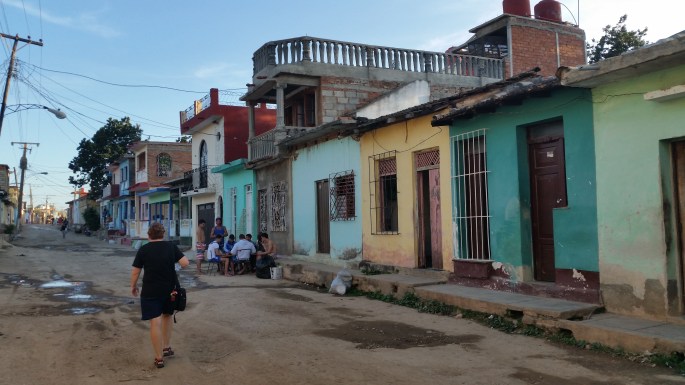
As with everywhere in Cuba, a walk down any street provides a glimpse into household life. All the houses open directly on to the pavement, usually with well secured large doors. As well, they all have large windows stretching from pavement level often to well above normal roof height. These windows do have shutters which are open during the day, there is no glass but are barred for security. Occasionally there is a curtain pulled across, but mostly the main living area is on full view. Invariably people are sitting watching the world go by, engaging in normal family life, or communing with passing friends or neighbours.
Cobbled streets in Trinidad are not easy to walk on
Warm greeting of friends is a big thing. Minimal would be a handshake, but a cheek kiss is a nice greeting no matter the age or gender of the friend. Young men greet each other with a cheek kiss for example but most strange to us is the cheek kiss greeting to work colleagues when you arrive for the day. Don’t think that will catch on back home any time soon.
We lunch one day in a small local restaurant close by. The food is tasty and inexpensive, unlike the Plaza Mayor experience. As with a few places, leaving your mark on the wall is part of the experience. Crayon is provided and chair standing on is encouraged in order to find a clear space. We add our mark to those from all round the world.
Most people know about kangaroos and one person even knew Skippy. We remembered we had some kangaroo photos from the trip to the Grampians. One man in particular in Remedios who had a small kangaroo on the back of his cap appeared to be quite overcome at seeing actual kangaroo photos.
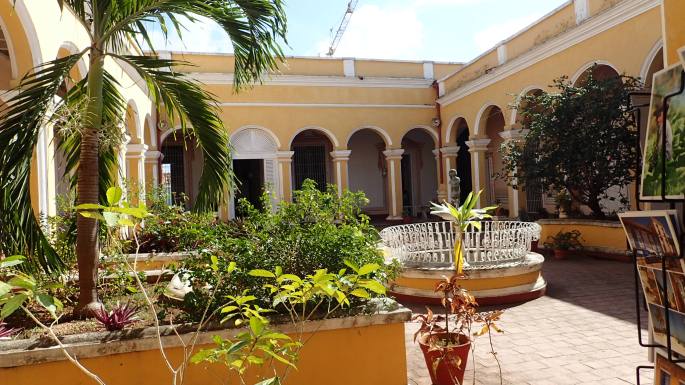
Apart from the music, there are museums in Trinidad that are worth visiting just to experience what were once grand and palatial homes. Staff are sitting, sometimes dozing, throughout but the museum artefacts are often carelessly displayed and totally accessible if you were foolish enough to try to walk off with an item.
As with every place we visit, there are a list of attractions that are touted as a must see or do while in town. Another 3 hour horseback ride is an option, but the tag line of “..to swim in the waterfall.. if there is any water”, tends to make this a less attractive option.
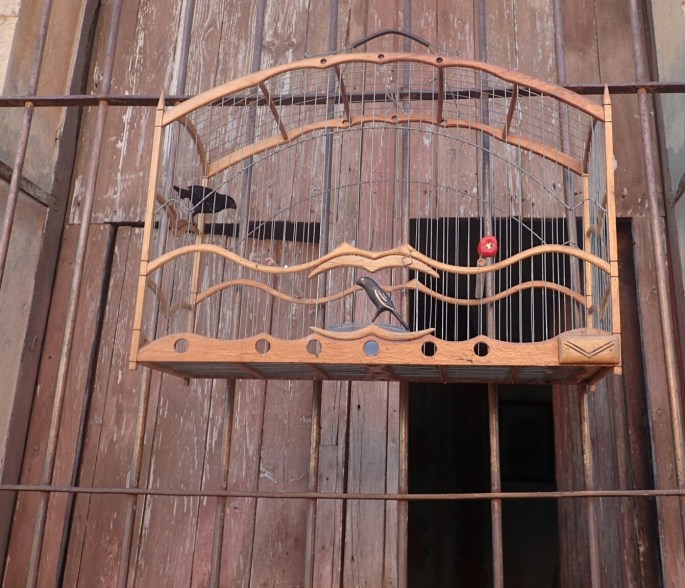
Lots of birdcages hanging outside. Love that cage design.
Another excursion we more or less experienced coming in from the north on the back roads. So that left the beach, promoted as one of the best beaches on the south coast. Playa Ancon is indeed lovely, and we have now officially swum in the Caribbean, but the Las Gaviotas beach experience (Cayo Santa Maria out of Remedios) was much more stunning.
Trinidad from a rooftop
Nonetheless, the tourists are here in their droves. Being sensible Australians, we find a good spot under a huge shade tree. The minute we start to pack up for the day, some Europeans feeling a little cooked in the heat are taking our places in the shade.
A rough timber shack, source of great music, is the drinks venue. Very civilised.
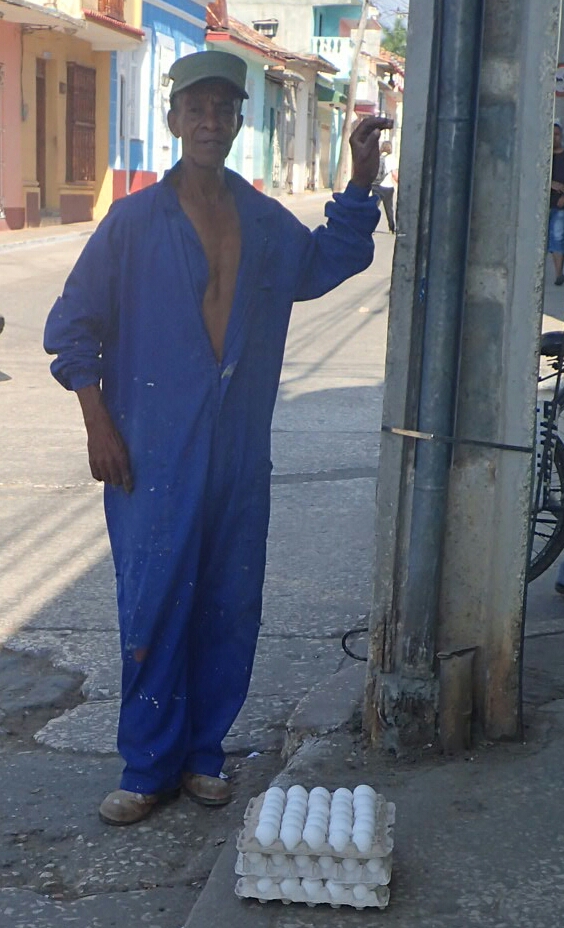
I am the egg man. People walk around with layers of eggs casually balanced making me nervous.
After close to 8 weeks without a haircut, I am starting to feel a little shaggy. Most Cuban women I notice have long hair so I’m not too sure how this will go, but I figure the moment is upon me. Lidsey from the Casa phones her friend and we take a bicycle taxi down to the premises. The proprietress has short blonde hair that appears to be somewhat permed so that is a bit encouraging. She however is busy with a regular client so someone also has been called in to do my cut.
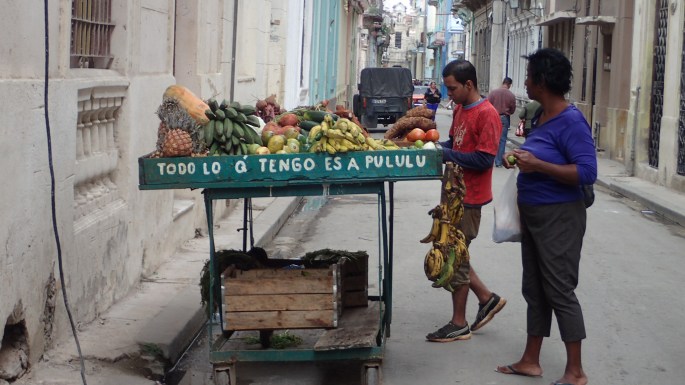
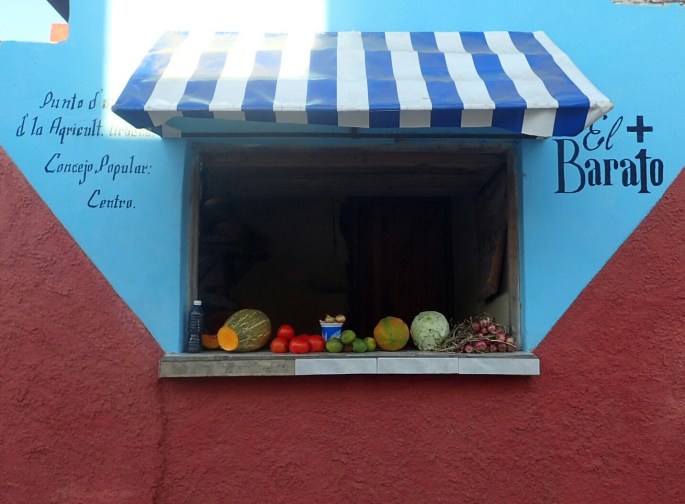
Fruit and vegie stall
I get the plastic drape and after a 5 minute small snip off the ends at the back and a bit off the fringe, I am brushed down and the plastic removed. No, no, I insist. I want equal amounts cut off from all over. This is a novel thought for my cutter but she cheerfully obliges and back goes the plastic. Just one more interlude where I still have great lanks in some spots and I find a photo of myself that finally gives them all the right idea – because it has in fact by now become a community effort.
The final result is not too bad. Think it will see me through.
The blue sign on the door indicates a registered Casa. The name of this one caught my eye.
There is a famous coffee place in Trinidad called Don Pepe where everyone goes to sit in a tiny area under trees, wherever you can really. The coffee is good there but we find Cafe Tuti much closer to home and are hugely impressed with the richness and full flavoured coffee.
Someone has spent good money tastefully on this small bar and Cafe. The bartender is perfect as he prepares the coffee with an economy of movement that is beautiful to watch. It’s hard to draw a smile out of him, but by our third visit, I am rewarded as we just pay correct money and get up to leave, a sure sign of “regulars”. Also, I seem to have perfected my request for two cortados sufficiently that I don’t draw a quizzical eehhh? every time I open my mouth. Now I will just have to work out the espresso machiatos again when we return to Peru.
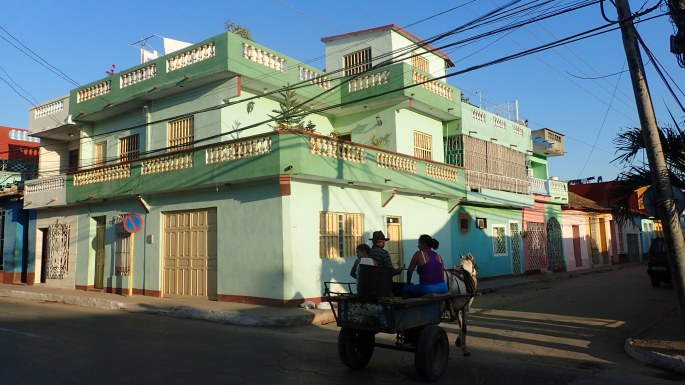
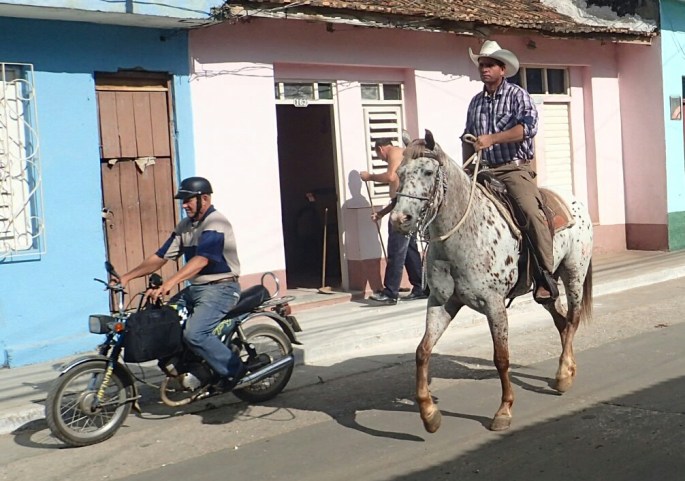
Plenty of Cowboys use our street as a thoroughfareWalking home
Perfecto, we seem to be finishing our 21 days in Cuba with a bang.
If I could start again knowing what I know now, I’d shave a day or 2 here and there and add a couple to Playa Larga. Still, I’m grateful we didn’t spend the night in the park in Vinales for want of being fancy free, the absolute ideal.
Caleton, the little town we stay in is also a place where virtually every home is a Casa offering rooms. It is right on the beach and would be unpleasant in a hurricane I imagine. Our hostess is totally gorgeous, a great cook and is familiar with gluten free, thanks to travellers who have come before.
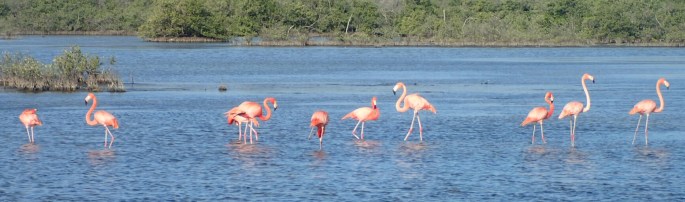
Our number one goal is to visit Las Salinas, home to up to 10,000 flamingo along with many other birds, Cuban and American crocodiles plus a variety of other creatures. The park is massive and starts just at the end of village.
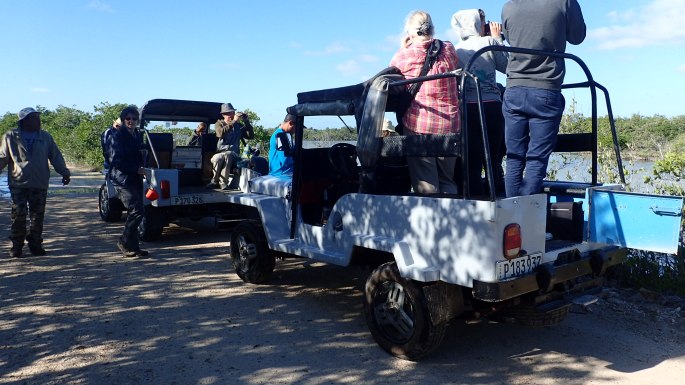
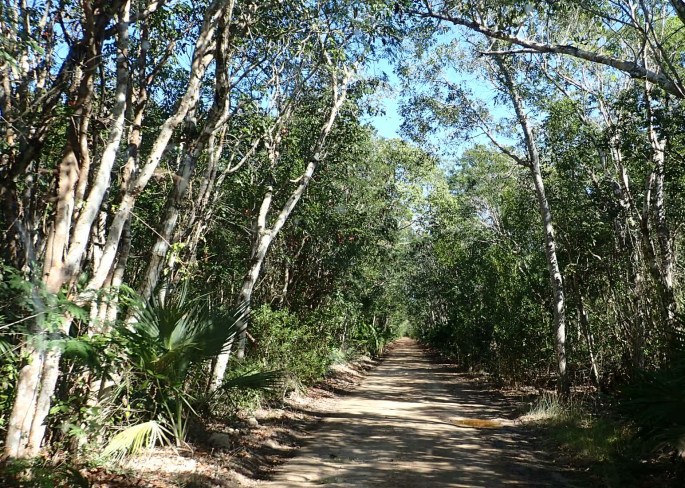
We are in the back of mini moke type vehicles and head off early with our guide and fellow travellers for a fabulous morning. The rain last night has left puddles on the firm dirt road. So straight, it seems to stretch infinitely ahead through dense shrub that eventually becomes mangrove, then savannah. We will drive about 23 kms, occasionally seeing the sea on our left, then fresh lagoons begin to appear.
Finally flamingo. They are a different species to the Galapagos flamingo and exceptionally pink. The lagoons are massive in parts, so at some spots, masses of flamingo are in the distance, and at others we are lucky to get great views. Seeing a flamingo spread it’s massive wings and take to the sky from close quarters is quite awe inspiring.
On this trip, we have to date only seen brown pelican, here however there are white pelicans and they are very big birds, bigger than the flamingo. Storks, tern, cormorant, Heron – our guide points out a Blue Heron in flight. I did clearly see the pink Spoonbill in flight, that was stunning. We have several variety of fabulous Spoonbill in our very own wetland at home, but this was a new one.
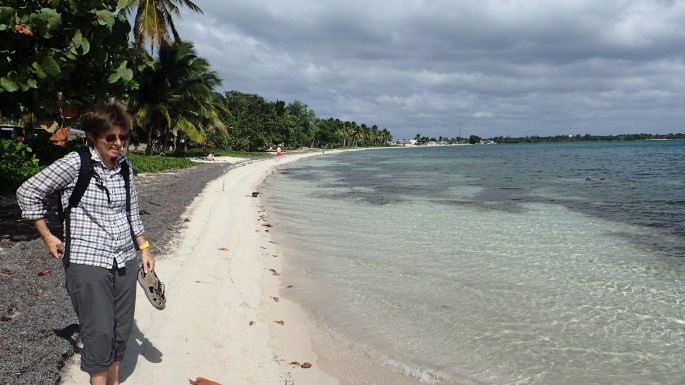
The wind has picked up and it’s not a day for swimming though the water looks fabulous. Lots of sea grasses which is why this is also home to the manatee. We opt for a very long walk along the narrow strip of sand following the bay around till we turn back in case the incoming tide forces us into the mangroves.
Boys play with kites, one snorkels looking for bait fish, and we pass just a few other walkers. With a variety of cocktail bottles set up on a tiny table on the sand, an enterprising bartender demonstrates right there on the open beach his talent for juggling bottles a la Tom Cruise and Bryan Brown in the movie Cocktail. Another man taps a rhythm on his small bongo drum to attract attention to his hummingbird wind chimes suspended from the bongo. This is the home of the world’s smallest bee hummingbirds.
Like a miracle, we can pick up WiFi on the terrace of our Casa. Very poor quality as everywhere else, but it is usually only available in a park or in a big hotel in a city so this is total luxury, even though we still have to use the purchased login cards.
Things are under construction everywhere in Cuba. Especially in smaller towns, one level, sometimes two, of a house is constructed and clearly another level will be added when funds are available. In some places, the builders were much more rough and ready with rusting iron protruding untidily from almost every house creates a decidedly unattractive effect. Here in Caleton, there is no rusting iron, but there are mounds of dirt and gravel scattered along most streets.
Not too much in the way of eating establishments in Caleton so we are happy to take up the offer of dinner each night. Last night chicken, tonight pork.
The food process is pretty similar everywhere and is an added extra option to the cost of the room. Breakfast is a plate of fresh tropical fruits, papaya, pineapple, guava, maybe watermelon or banana in some combination of at least three. There are bread rolls and usually some sweet pastry or muffin with a main dish of eggs as you like them with ham and cheese plus usually some salad. Thermos of coffee, hot milk and hot water are on the table plus there is a large jug of juice. Occasionally a large amount of added sugar makes the juice undrinkable for me.
Dinner will be soup, followed by a large salad, cabbage seems to be popular, but nice tomato and cucumber. Then the main meal, a good cut of whatever you have chosen. Chicken, pork, shrimp and in some places lobster or crab are options all served with rice, sometimes black beans, and vegetables. Then there is a dessert of a flan or something nicely preserved fruits. All of this for CUC$10 or Euros10 and a bit more in Aussie$. A bit more if you get lobster as well.
Today we enjoyed street food snacks of churros and for me maize fritters. A bit of a mini dough binge after no gluten free bread like products of any kind for weeks.
Getting from place to place has not proved problematic. The Viazul bus didn’t really work out for our itinerary so we have used taxi collectivos exclusively. Costs a little more, but they leave in the morning and do a pickup plus delivery to your next casa.
How auspicious is our very last collectivo back to Havana in the morning? We are approached by a guy on the way back from the beach. Havana tomorrow? No but seems like this is time to tee up our onward journey. His name is Kenny and he is from Australia, which amazingly, is a town just down the road from here. We seal the deal with a handshake, feeling a special bond with Kenny, especially when I tell him my brother is also Kenny. He is super impressed.
Casa Ileana has just been a gorgeous if brief stay. She is such a warm, happy soul who clearly loves having guests in her home, making us feel quite special. Warm hugs all round on our departure.
Almost feels like home heading north out of Cienfuegos to Remedios. Mile after mile of sugar cane, plenty of mango trees, bananas and more sugar cane.
Just 4 of us and the driver in the 6 seater car to start with. Two Italians get out at Santa Clara to check out the Che Guevara museums for a few hours. People are thumbing all along the road and we collect a couple with 2 children, then 2 more men squeeze in the back for a while making 6 in the back bench seat. We hurtle along at what feels like break neck speed but I can’t seem to see a functioning speedo.
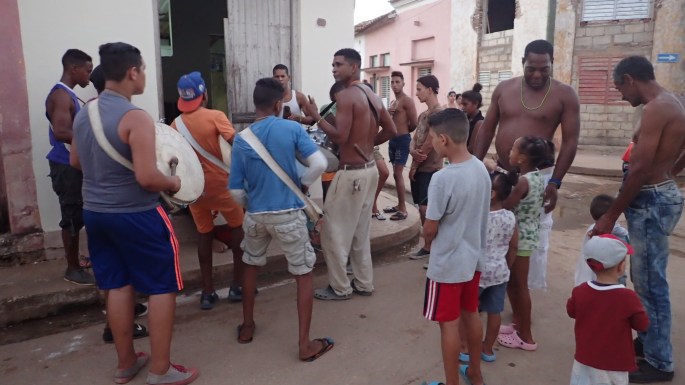
The drumming performance on a stretch corner reverberated right through my body. Phenomenal beat.
We arrive at our Casa and Jose rushes out to welcome us. He announces he has sick people (more Italians) staying over time, so we get back in the Dodge and go round a couple of corners to a recently opened casa run by his nephew and wife. What a lovely place and a lovely couple.
Remedios
Love the variety of doors, especially old timber
Called La Eden, the terrace up on the roof has the appropriate decoration. Apparently we will play dominoes up here tomorrow night. A popular past time throughout Cuba, we saw people playing it this afternoon at a table set up right in the street.
There is a very generous kitchen where a beautiful dinner is prepared. Fresh guava and papaya, a very tasty tomato and cucumber salad, pork steaks cooked in garlic with yucca, rice, more salad and hot chips. Finally, some kind of poached fruit with fresh cheese and brewed coffee.
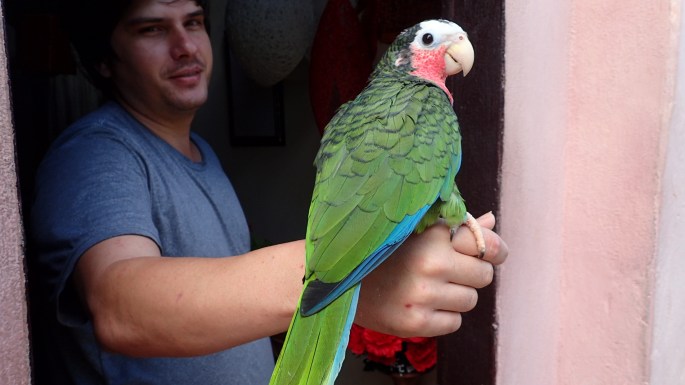
This Cuban parrot is a very popular household pet.
They have a caged bird, a pretty parrot that has quite a vocabulary. It was obviously feeling very abandoned one evening and had a most fascinating outrage at its predicament. We found it very entertaining, but that was only for one evening.
We stroll around the square on a very balmy evening. The stars are out, not many lights, and plenty of people are out in the square as well. Very tantalising music flows into the streets from many houses, but as far as we can see, none of the bars or restaurants have live music. There could be a dancing place on the other side of town, but we would get lost trying to find it in the dark. It is a tiny town but still maybe 20,000 population. A big day out tomorrow so even though it is new years eve we get an early night. It’s already well into the afternoon of new years day in Australia.
Dominoes is very popular. Street games all over and very vigorous play.
Remedios is close to Cayo Santa Maria, an area that is being developed as a resort strip in Cuba. Charter flights come in and it apears tourists never see anything of Cuba other than the isolated resort. Seems bizarre to us.
Lovely walk to Las Gaviotas
Having heard a taxi one way could be around A$100, we are pretty happy to organize a full day for round about two thirds that price. Our gorgeous hostess prepares a feast with enough food for a week and we rumble out in another old car. This one has intact window winders and they are very schmick matching the door handles in chrome and what looks like bakelite trim.
There are just a couple of small towns before we hit the causeway. Passports are required for the checkpoint. Everything in Cuba is highly regulated. As we progress a little further along, a giant toll way booth is under construction.
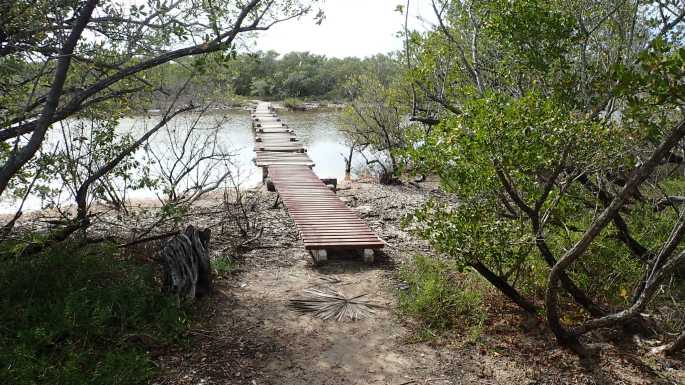
About 20 kms along the causeway, mangroves start to appear dotted around and gradually in increasing clumps. Bridges are interspersed along the causeway averaging out to roughly one every km. It is very beautiful with the sun glinting on the ocean on either side of us.
Flamingo in northern Cuba
Our number one target for the day is finally spotted around the 50km mark. Here are the flamingos surviving in spite of the construction of resorts which are now evident.
Their habit is surrounded by low bushes so not easily accessible, but we get some great views. Very exciting.
Must be good food wading in deep water though more likely thick mud sediment
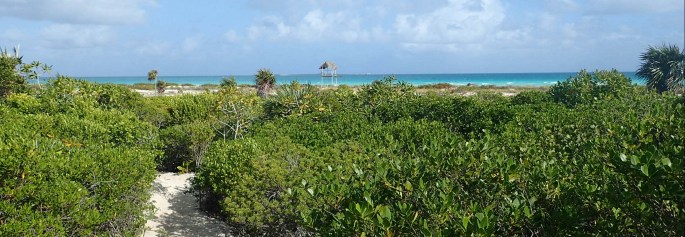
Just a few kms further on, we reach our beach destination for the day, Playa Las Gaviotas. It is a 15 minute walk along a track through low growing scrub, pandanus and cactus until the track turns to sand and then a spectacular burst of jaw dropping ocean vista brings us to a halt.
First view of the ocean was jaw droppingly beautiful
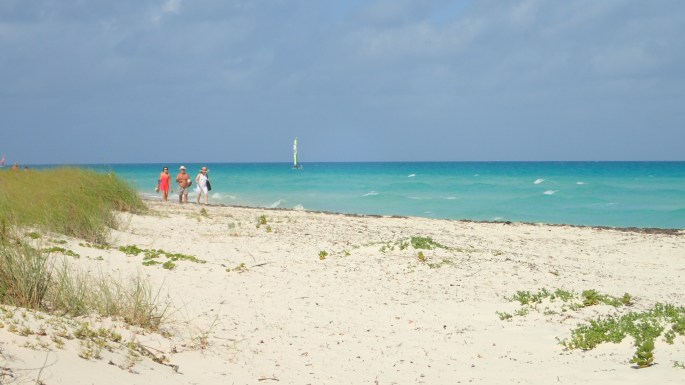
The ocean is the legendary gorgeous range of fabulous blues, the sand is white and extends for several kms. We are early and virtually no one else is there. We choose a spot at a little low palm thatched cover and test the water. It is cool but lovely.
Think this is the first ever swim in the Atlantic.
Stunning beach in northern Cuba. Las Gaviotas
We lounge for about 5 hours, nibbling at our feast, reading, strolling, taking a dip, then watching a large party of Italians construct enormous sand creations complete with vegetation to enhance the effect.
Such a lovely walk to the beach
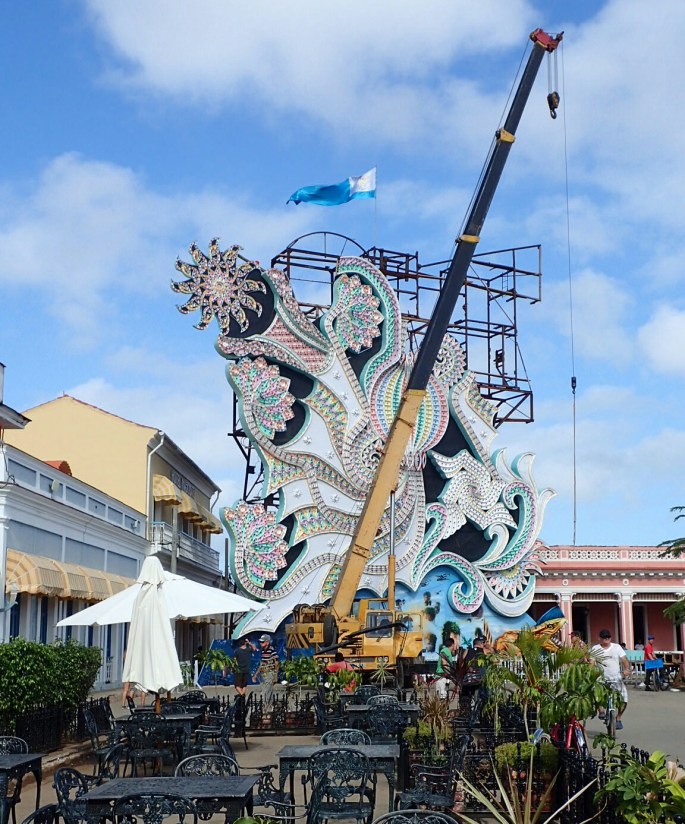
Remedios is is the only town in Cuba with two churches on the main square. It also has reputedly the longest running bar in the whole of Cuba, Le Louvre also on the square. We spend most of the next day here sipping limonade frappes, enjoying the music and watching the preparation for the Parrandas along with half the town it seems. This festival is usually held Christmas Eve but was cancelled this year due to the death of Fidel. It has been rescheduled to this week and there are two cranes helping to erect giant decorations that will clearly be the centerpieces of the celebrations.
Las Pallandras setting up Remedios
Plumbing is a challenge in Cuba and each place we go seems to have its own individual quirk calling for creative solutions sometimes.
Quite late the other night, I heard a cry “Oh my gosh”, quickly followed by an even more urgent “Oh my God!” I know it is a man who has never in his life before encountered such a plumbing phenomenon. Much bucket sloshing followed by quiet and I guess he has resolved the problem. Still makes me giggle.
Next door to our Casa is a facility for people with disabilities. We meet the jefe who shows us photos of various activities, the place being closed now for new year holidays. He lost a leg to a grenade in Angola in 1975 where apparently many Cubans went to fight and provide other services such as medical and administrative. A well travelled Cuban, he played basketball in the London Para Olympics.
Lovely man, lost his leg to a grenade in Angola
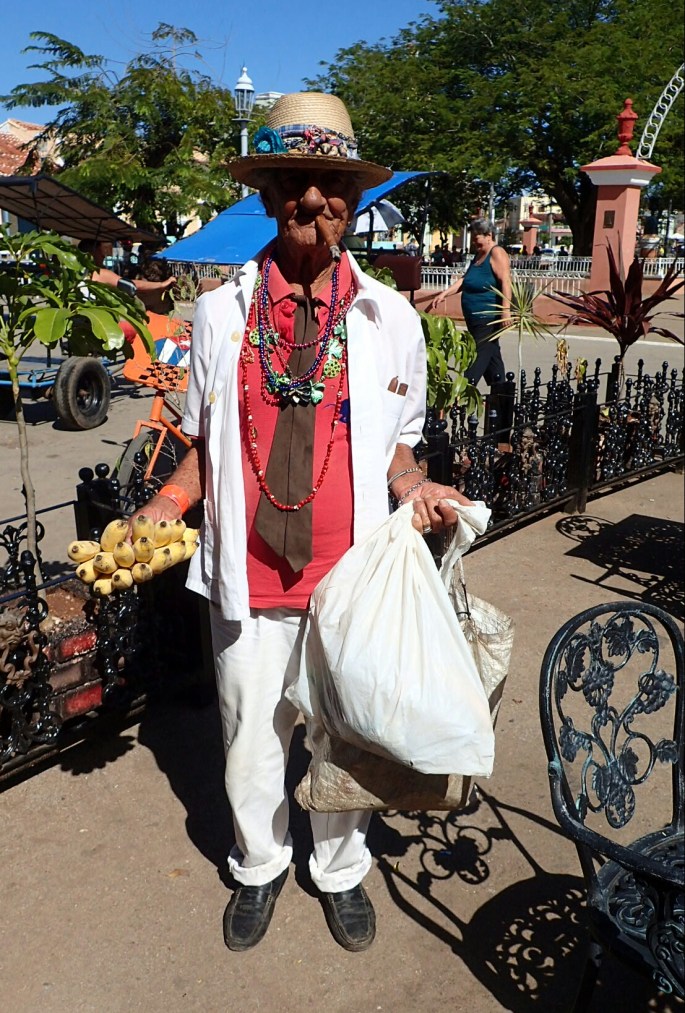
Remedios is a small town that may not suit many travellers but it is full of interesting characters just like every place, if you have time to sit and talk. We met one old man selling small cones of peanuts, pretty blind at age 84, but happy to chat. Another total character dressed in the distinctive Cuban whites, puffing a cigar and selling bananas.
Onward transport out of Vinales. This was the travel style for the next fortnight.
The journey out of Vinales feels like we are either in a National Lampoon Vacation movie or perhaps a Mafia movie. A long line of 9 seater 50’s classic cars packed with foreign travellers, roof racks loaded up (maybe not Mafia) chugs up the 5km climb trapped behind trucks and slower vehicles. We suck in the fumes and feel fairly confident in our drivers ability.
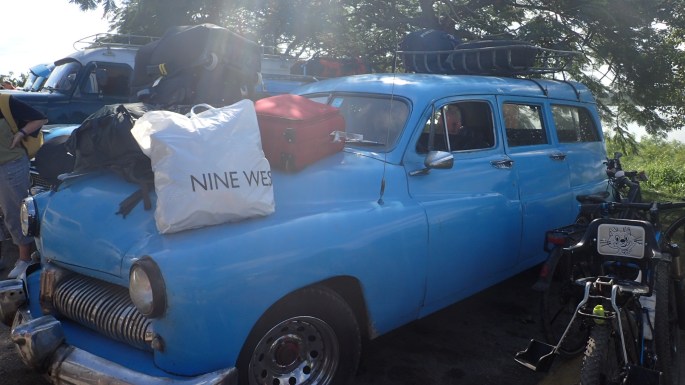
Packs off one roof rack onto a nearby bonnet till the changeover car is organised
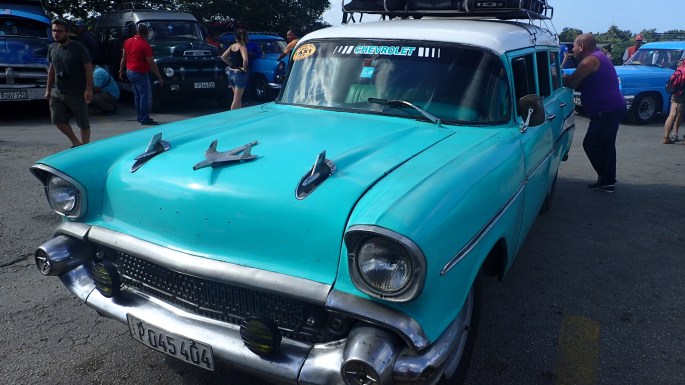
About 2 hours in, we pull over to a scene of highly organised chaos. This is the changeover spot and there are dozens of vehicles just like ours who have arrived from Vinales and many other places. People and packs are disgorged to be reallocated to another vehicle for the final destination. We are heading to Cienfuegos so we get loaded into the last 2 seats in a big Chevy.
The klaxon, definitely not a horn, is activated by a taut string suspended from the top of the door down to the dash. A tapetty tap tap of fingers or a nifty forearm jab achieves the desired effect on passing vehicles, pedestrians or whatever takes the drivers fancy.
Definitely a meaty arm
A waggle of a meaty arm out the window acknowledges passing friends, or a thanks to a headlight warning flash from an oncoming vehicle. We are entertained by music videos. As the car absolutely flogs down the open road I realise we are dead if a tyre was to blow. Best just to relax and let the wind rip through your hair from the permanently open window.
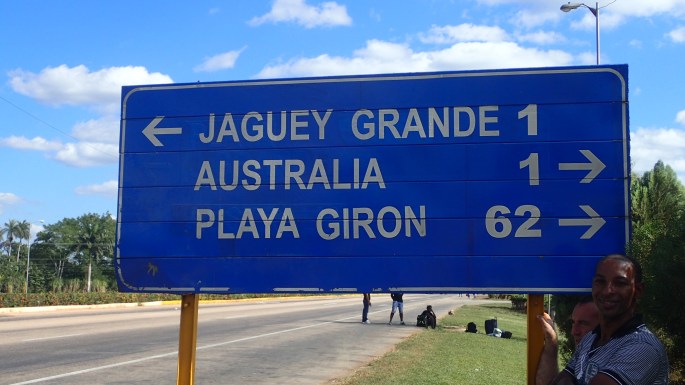
After a couple of hours we stop at the turnoff to Australia for a snack and the bano. We will be back in this area in our last week, for a beach break in the Bay of Pigs.
For the record, the signpost to Australia in Cuba which is on the way to the Bay of Pigs
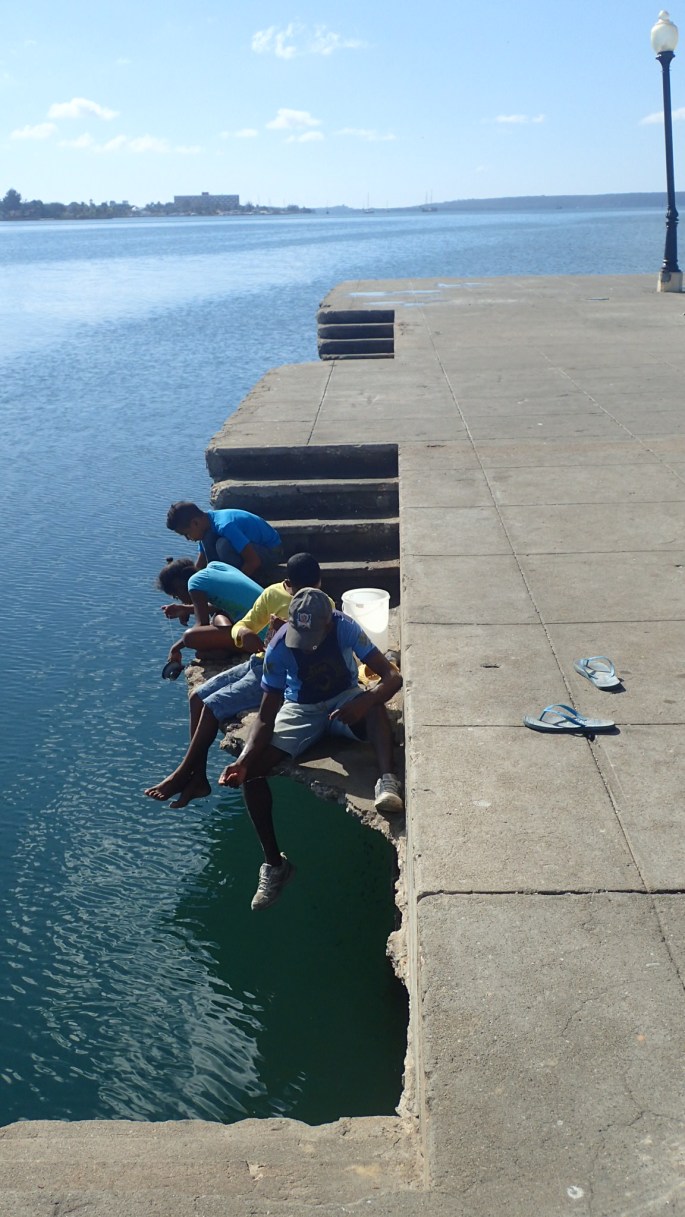
Sunlight really does sparkle like diamonds on Cienfuegos bay. The water is shimmering in the light and not a ripple breaks the spectacular effect on this hot morning. Boys throw fishing lines in off the decaying cement jetty. We can see the water is teeming with tiny fish.
Cienfuegos Bay is sparkling
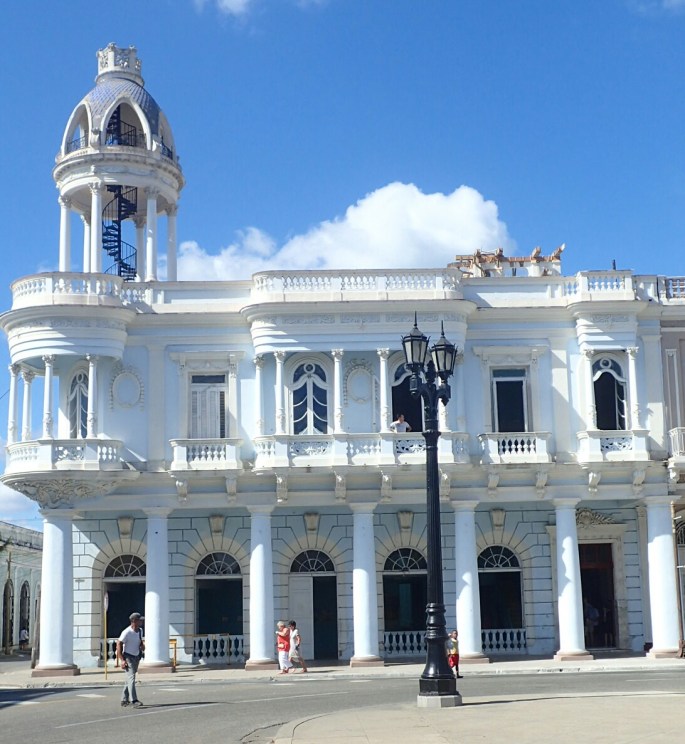
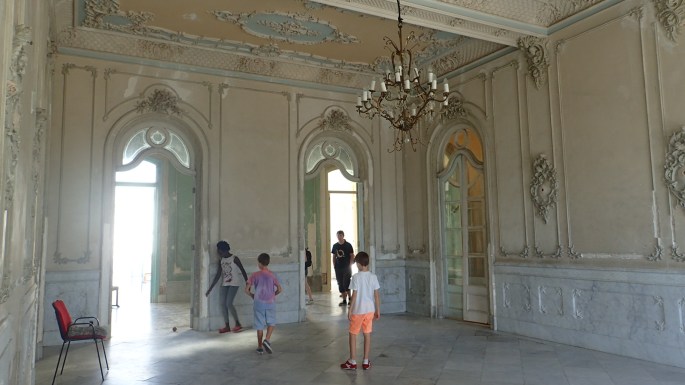
A pedestrian boulevard lined with shops leads to the beautiful Jose Marti Square with its strong French influence in the town planning and design. Unlike Havana, the majority of the major buildings are in pretty good condition. We pay CUC$2 to go into a building that is in bad disrepair internally and looks a bit like a construction site. It feels like the construction will be continuing for many decades.
Beautiful Cienfuegos
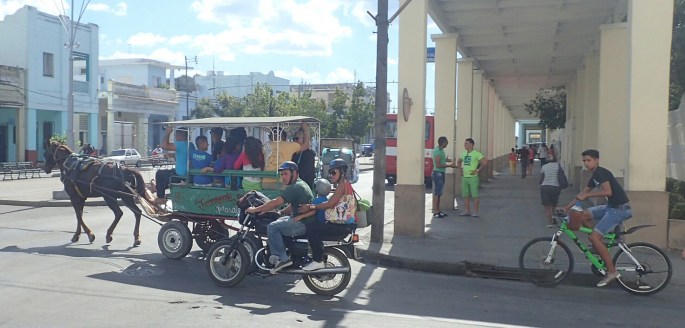
Bicycle taxis ply up and down the Malecon offering their services. Many of the locals use these and others pile into carts pulled by horses to get around town. For longer distance travel, people often cram into large covered trucks and are transported standing up.
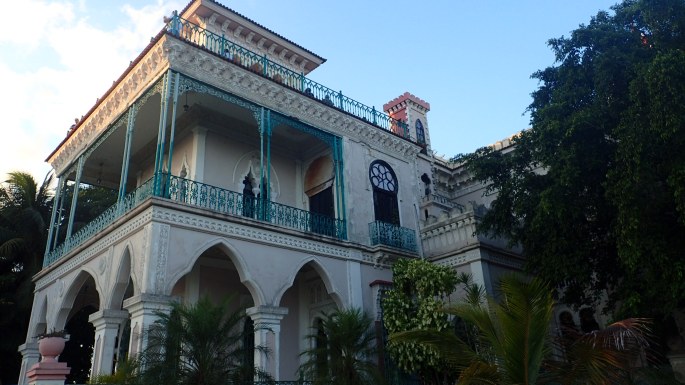
Looks amazing but pretty derelict and dangerous in some parts.
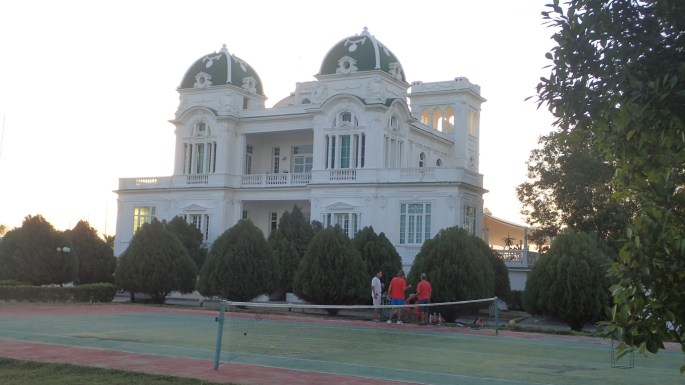
At the other end of the Malecon is La Punta. A great place to stroll and catch the fabulous sunset over the bay. The sugar barons had their homes in this neck of the woods. Some spectacular places remain. On this quite small strip of land, the grand homes have a double water frontage on their east west aspect. Many are now Casas renting out rooms.
Our Casa is nicely located close to the Malecon and about a 10 minute walk to the centre. We have our own entrance in the spacious home that is a bit of a menagerie. They have dogs, caged birds in several locations, chickens wandering freely outside and a pond arrangement in the large open dining area that houses amongst the fish and a turtle, a small crocodile.
I asked Santiago, the Grandfather what would happen when the crocodile grew. He made a cutting motion across his neck which seemed a bit of a violent end for an occupant of the premises. Still, I suppose it happens to the chooks.
The grandmother of the house prepared a lovely breakfast every morning. She reminded me of Dorothy from the Golden Girls with her stature and voice.
Tropi Sur is tempting for a night of Cienfuegos entertainment. Only CUC$3 (less than A$5) for a show but the doors don’t open till 9.30 with showtime at 10.30. We are pretty tired after walking 27kms today, according to the smartphone pedometer, so retire for the night. We saw a little bit of rehearsal and while nothing like Tropicana in Havana for about about 25 times the price, would have been fun.
We enjoy the feel of Cienfuegos, getting a little more laid back and quite beautiful in parts. After a long hike towards the bus terminal, we meet Carlos who turns out to be the go between to organise our next taxi collectivo ride on to Remedios.
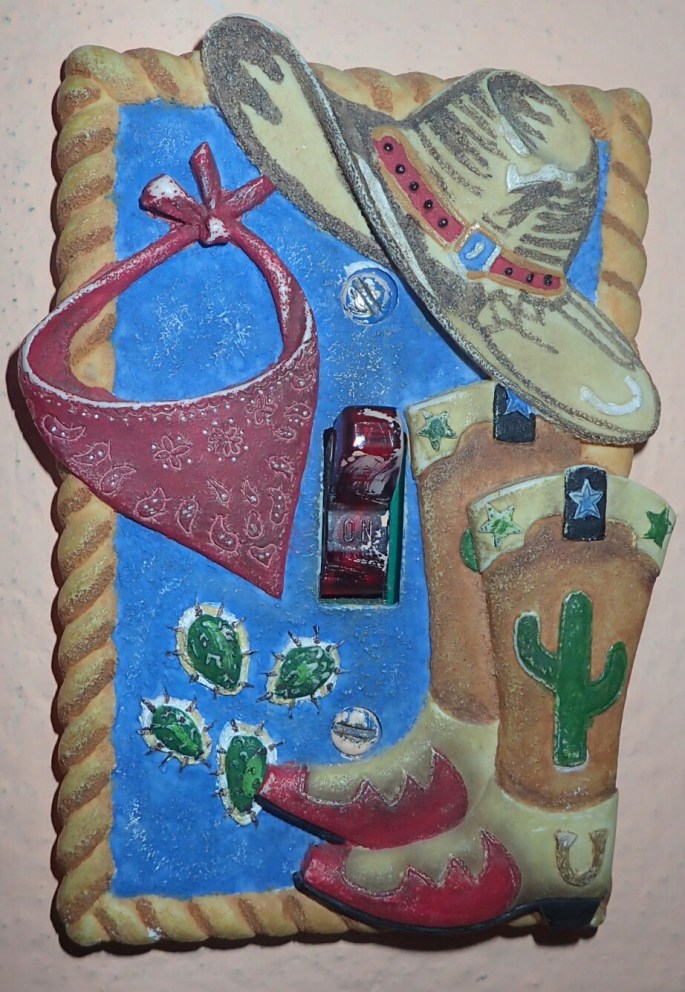
Pretty cute light switch in our Casa
No need to panic about getting from A to B in Cuba, there is always a solution. There is a system, not always visible, but it’s friendly, reliable and trustworthy.
When your horse is called Coco Loco, this cannot be an auspicious start to a three hour horse riding trek.
Many people, few horses – an exclamation from the owner, gives the game away. It goes some way to explaining why I am lumbered with a horse called Coco Loco! Also the name of a local cocktail.
Vinales is packed to the eyeballs with foreigners all wanting an experience of some kind and horse riding is one of the very popular experiences.
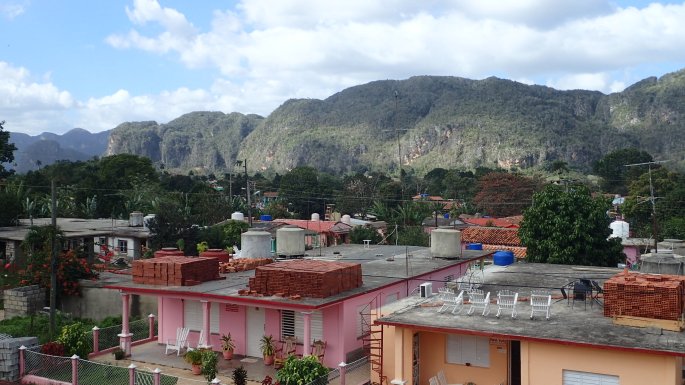
View from the roof Vinales
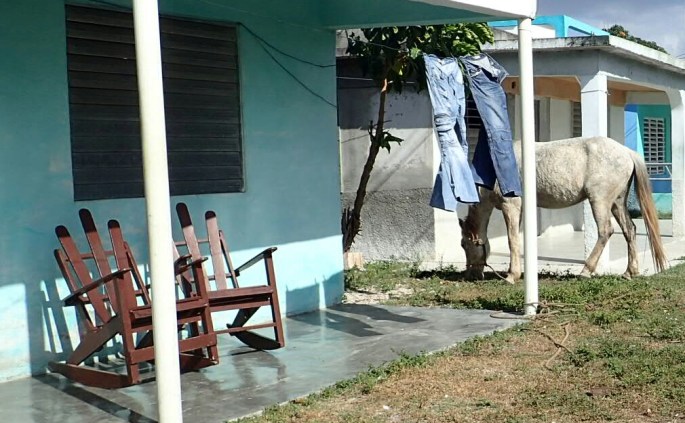
The clip clop of horses hooves down the street is in fact a bit of a signature note for Vinales. That along with people sitting in their metal or slatted wooden rocking chairs either out on the porch or up on the flat roof enjoying the cool of the evening.
About a 3 hour bus ride out of Havana, the trip was comfortable, but the day has been hot and we are a little travel weary. That can’t last too long though as the horseback excursion on Coco Loco and Mojito awaits us in the morning.
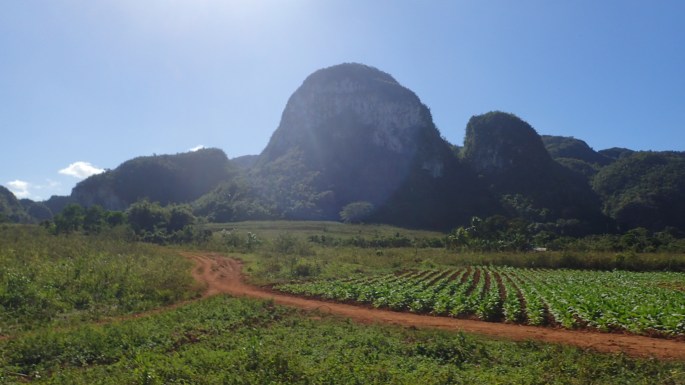
Limestone outcrops are impressive.
As a non horse rider, a horse riding trek, no matter how short, is unexpected even for me. Maybe not quite up there with snorkelling with sharks, but it can certainly go on the list.
After about half an hour, my pommel clutching grip starts to loosen and I worry less about having bruised hands from hanging on so tightly.
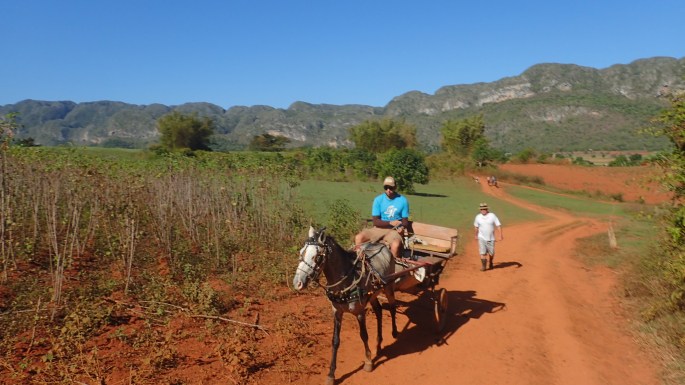
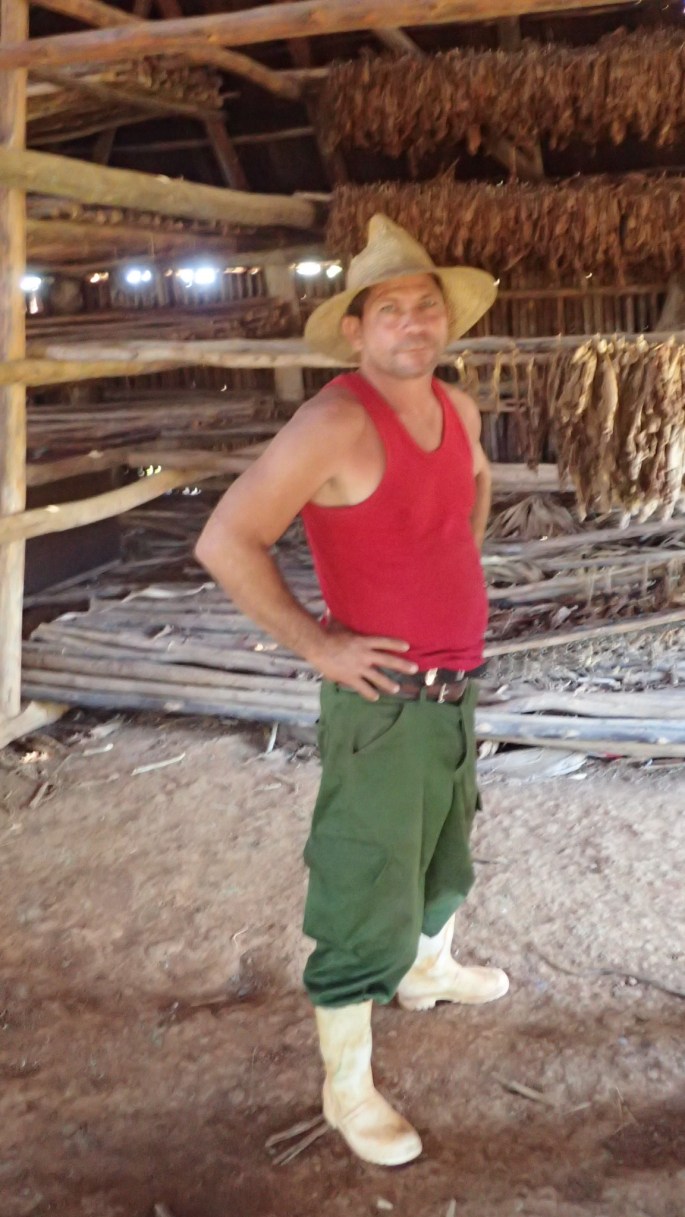
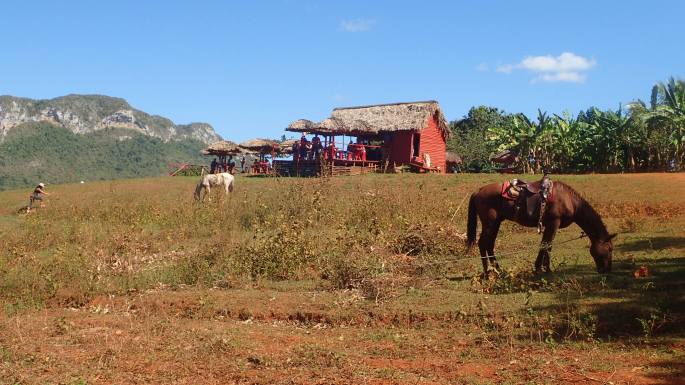
Red dirt tracks meander around the surrounding farmland where tobacco farms operate, I suspect in this area at least, deriving their income mainly from catering to the tourist experience. The limestone outcrops make for a spectacular backdrop. Birds of prey are prolific in this area and they hover and swoop wherever we are.
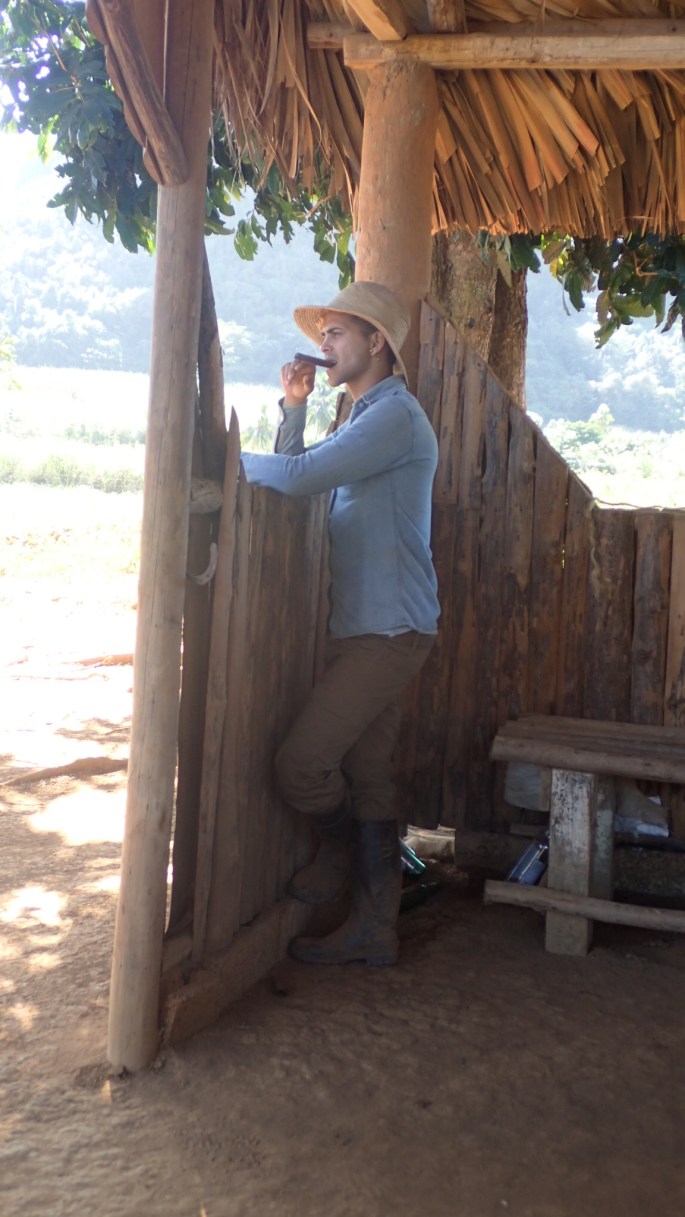
The campesino we talked to, a short but striking man, explained that farming is highly regulated and that 90% of his crop had to be sold to the Government.
The campesino explains how tobacco farming works in Cuba
Part of the horse riding experience is to stop at a little bar on a hill to enjoy a cold drink or a snack and enjoy the live music.
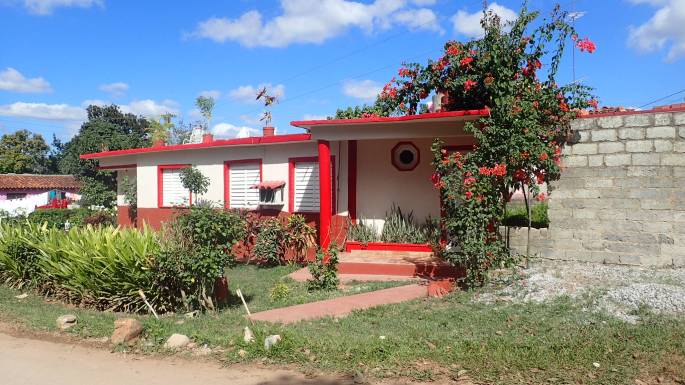
It appears that the vast majority of Vinales residents have long ago forsaken farming to be part of the tourism boom. Street after street is lined with houses offering rooms to rent. There are hundreds of Casas operating here. Even so, last night Vinales was full and people slept in the park.
Cocktails and live music are even available right out here
In spite of the hordes of visitors, it doesn’t feel as bad as it sounds. Reminds me just a little, of experiences in Australia where people might travel for a couple of hours on a Sunday to throng the streets of a popular and picturesque village. Quite different of course, and here it is a daily event. But all of us are here with a common purpose, to participate, eat, drink, enjoy and in general spend a bit of money. Most importantly of all to enjoy Cuba.
Patience is the word in Cuba when it comes to the internet. Bars, restaurants, Casas have all moved a reasonable distance into the 21st century catering for travellers. Etecsa is still grinding along in another bygone century somewhere far away.
We queued for a good hour in the sun waiting to buy a login and password. In Havana, we paid top $ but got a card in seconds. Here in Vinales, you have to explain what you want even though odds are pretty high that every foreigner is after the same thing. The process then involves tediously taking passport details before handing over the goods in exchange for money. It explained why it took a good 5 minutes or more before someone emerged from the door and one more person was allowed to just get inside the building.
As it turned out, the first login I tried did not work, the second barely lasted 30 minutes out of the supposed hour. Woe betide if you only purchased one ticket.
Vinales is super full of tourists and numbers swell even more with day trippers, certainly over this Christmas season at least. While travelling onward as the mood strikes is the way to go in an ideal world, in the busy season booking your Casa well ahead could save some heartache and tears. In spite of that, Vinales offers yet another window onto the diversity that is Cuba and is worth a look if you have time.